How to Create Real Estate Videos Buyers Actually Watch Until the End
Publicado:
August 19, 2026
Most real estate videos have the same problem: they look like property tours, but they feel like homework. The video opens with a slow exterior shot, moves through the front door, pans across the living room, pauses on the kitchen, walks upstairs, shows three nearly identical bedrooms, and finally ends in the backyard. Technically, everything is there. Emotionally, almost nothing happens. A buyer may be interested in the home, yet still leave the video after a few seconds because the content never gives them a reason to stay.
That matters because attention is the real currency of real estate video marketing. A beautiful house doesn't automatically create an interesting video, just as an expensive camera doesn't automatically create an engaging movie. Buyers are constantly scrolling past homes, market updates, renovation clips, neighborhood tours, mortgage discussions, and dozens of other distractions. Your video isn't competing only with other listings. It's competing with everything else on the screen.
The good news is that you don't need dramatic cinematic equipment or a luxury property to hold attention. What you need is structure. Buyers keep watching when they feel that something useful, surprising, relevant, or emotionally interesting is about to happen. They want to understand the property quickly, picture themselves inside it, and decide whether it deserves more of their attention.
Think of a strong real estate video less like a digital open house and more like a great trailer. A trailer doesn't show every scene. It chooses the right moments, creates momentum, and makes you curious enough to want the full experience. Your property video should do the same thing.
The goal isn't to squeeze the entire listing into sixty seconds. The goal is to create enough curiosity that someone watches until the end and takes the next step. That might mean asking a question, requesting the details, saving the property, sharing it with a partner, or scheduling a showing. Every editing decision should support that journey.
Here's how to make that happen.
Why Most Real Estate Videos Lose Viewers So Quickly
Real estate videos usually lose viewers for one simple reason: they start by serving the property instead of the viewer. The creator wants to show every room because every room feels important. The buyer, meanwhile, is silently asking a much more basic question: "Why should I care about this house?"
If you don't answer that quickly, the viewer leaves.
A common opening looks something like this: a wide shot of the exterior, five seconds of walking toward the front door, a slow pan across the foyer, and then another slow pan across the living room. Ten or fifteen seconds can pass before anything truly interesting appears. To the person who created the video, this feels elegant and professional. To the viewer, it can feel painfully slow.
Another problem is information overload. Some videos try to communicate the price, bedroom count, square footage, upgrades, taxes, neighborhood, school information, lot size, renovation history, and every appliance included in the sale. That's too much information for one short video. When everything receives equal emphasis, nothing feels important.
Then there is the opposite problem: pretty footage with no context. The kitchen looks nice. The backyard looks nice. The primary bedroom looks nice. But why is this home different from the last fifteen homes the buyer saw? Aesthetic footage without a point becomes visual wallpaper.
Strong videos create a reason to continue watching. Maybe viewers want to see the unexpectedly large backyard mentioned at the beginning. Maybe they're waiting to discover the feature that makes the floor plan unusual. Maybe you tell them that the best part of the home isn't visible from the street. Curiosity gives the video momentum.
This doesn't mean using artificial tricks or exaggerated claims. You don't need to tell people, "You won't believe what's upstairs!" when upstairs contains an ordinary bathroom. That kind of manufactured suspense damages trust.
Instead, use genuine specificity. If the house has a hidden pantry, show it. If the primary suite opens directly to a patio, tease that early. If the home looks modest from outside but has a huge renovated interior, build the video around that contrast.
People keep watching when they sense that the next few seconds will reward their attention.
Start With the Buyer, Not the Property
Before recording anything, ask yourself who would realistically become excited about this home. That doesn't mean identifying buyers by protected personal characteristics. It means thinking about lifestyle, priorities, routines, budget expectations, and space needs.
Consider a small urban condo with no yard but incredible walkability. If you shoot that property like a suburban family home, you'll fight against its natural strengths. Instead, create a video around convenience. Show the morning coffee spot nearby, the compact but efficient kitchen, the workspace near a window, the building entrance, and the evening walk to restaurants. You're showing why the property makes sense for someone who values location and low-maintenance living.
Now imagine a larger house outside the city with a big yard, garage, and flexible bonus room. That video should feel different. You might highlight storage, outdoor space, privacy, work-from-home possibilities, and areas where people can spread out.
The building determines what you can film. The buyer's likely priorities determine how you should frame what you film.
A useful exercise is to complete this sentence before every shoot: "The person who will love this home most will care about ______." Fill in the blank with something real. Maybe it's privacy. Maybe it's entertaining space. Maybe it's affordability relative to the neighborhood. Maybe it's the ability to work from home without sacrificing a bedroom.
Once you know that, your video becomes easier to edit because you're no longer treating every feature equally.
Suppose the strongest buyer benefit is entertaining. The video shouldn't spend eight seconds showing a laundry room simply because the laundry room exists. Spend that time showing how the kitchen flows into the dining area, how the patio connects to the living room, and how the backyard gives guests room to spread out.
This approach also makes the video feel personal without becoming overly sales-heavy. You're not yelling features at people. You're helping them evaluate whether the property fits their life.
A buyer doesn't really want "four bedrooms and three bathrooms." They want to know whether one bedroom can become an office, whether guests can stay comfortably, whether the morning routine will be chaotic, and whether they'll still enjoy the home three years from now.
Your video should translate real estate features into those everyday experiences.
Win the First Three Seconds With a Strong Hook
The opening of your video is not the place for a slow introduction. It's the place where you earn the next few seconds.
Think about how people actually consume property content. They're not sitting down with popcorn and announcing, "I'm ready to study this listing." They're probably holding a phone, half-distracted, moving quickly through content. Your opening must communicate relevance before their thumb moves again.
A strong hook usually falls into one of several categories: surprise, specificity, contrast, curiosity, or direct buyer relevance.
Instead of opening with, "Welcome to this beautiful three-bedroom home," try something more specific: "This house looks small from the street, but wait until you see what happens behind the kitchen." That creates an unanswered question.
Or lead with value: "If you've been trying to find a home with a real office and a backyard under this price point, look at this."
Another effective hook highlights a tradeoff: "You give up a little bedroom size here, but you get one of the best living spaces I've seen in this price range." That sounds more believable because it doesn't pretend the property is perfect.
You can also start directly with the visual payoff. If the backyard is the hero feature, don't make people wait forty seconds to see it. Open with a one-second glimpse, then pull back and explain how the rest of the property connects to it. Movie trailers regularly show flashes of their biggest moments. Property videos can use the same principle.
Your hook should be easy to understand with the sound off because many people encounter videos silently at first. A clear piece of on-screen text can help reinforce the opening idea.
Avoid vague hooks like "You need to see this!" or "This home is unbelievable!" They demand attention without explaining why the viewer should give it.
Specificity wins.
"This kitchen has more storage than some entire apartments" is interesting.
"Wait until you see this kitchen" is generic.
The strongest hooks also match what comes next. If you promise a surprising basement feature in the opening, don't make people wait until the final second to see it unless the payoff truly deserves that buildup. Curiosity should create momentum, not frustration.
Build Every Property Video Around One Clear Story
A house may contain twenty features worth mentioning. Your video does not need twenty stories.
Choose one.
This is one of the biggest differences between average property content and videos that people willingly finish. Average videos try to document the property. Strong videos interpret the property.
Imagine you're filming a house with a remodeled kitchen, a large yard, a basement office, an updated primary bathroom, and a two-car garage. You could create a video that briefly shows everything. Or you could build a video around the idea, "This house was designed for people who never want everyone crowded into the same room."
Now the footage has a purpose. You show the open kitchen where people can gather, the basement where someone can work or watch a movie, the backyard where guests can spread out, and the primary suite where the owners can retreat afterward.
That's a story.
Another video about the same house might be built around, "Three things that make this home easier to live in than it looks online." The story could include storage, the connection between indoor and outdoor space, and the separation between bedrooms and work areas.
The property hasn't changed. The editorial angle has.
A simple structure works well: start with the promise, provide two or three supporting moments, reveal the strongest proof, and finish with a next step. That's enough architecture for most short property videos.
If you're creating something longer, you can use a more complete narrative. Introduce the property's strongest idea, explain why it matters, show the spaces that support it, acknowledge one meaningful tradeoff, and end with your overall interpretation.
Think about how you describe houses after an in-person showing. You rarely tell a friend, "I saw four bedrooms, three bathrooms, 2,450 square feet." You say, "The backyard was unbelievable," or, "The upstairs was small, but the main level felt huge."
That's how people remember homes.
Your video should help them form that sentence.
If viewers finish your content knowing exactly what makes the property different, you've done more than give them a tour. You've given them a reason to remember it.
Show the Experience of Living There, Not Just the Rooms
Empty rooms are difficult to connect with emotionally because buyers don't actually want rooms. They want mornings, dinners, quiet evenings, workspaces, weekend gatherings, storage that doesn't make them lose their minds, and enough separation to live comfortably.
A good real estate video helps the viewer mentally move into the property.
Instead of simply filming a breakfast nook, show why the morning light makes it interesting. Instead of showing a balcony from one static angle, step outside and capture the view someone would see while sitting with coffee. Instead of slowly panning across the kitchen, demonstrate how close the refrigerator, prep space, stove, and dining area are to one another.
You're not producing fantasy. You're illustrating function and experience.
Small details can do a lot of work. Record the front door opening into the main living space so viewers understand the arrival experience. Film the path from the kitchen to the patio to show how entertaining might work. Walk from the primary bedroom into the bathroom and closet so people understand the relationship between spaces.
If the house has a great window view, don't simply film the window. Start inside the room, move toward it, and let the view reveal itself naturally.
The same principle works in more practical homes. Maybe the biggest strength is a mudroom directly off the garage. That's not glamorous, but anyone who has walked into a house carrying groceries in the rain understands why the layout matters. Show the path.
A useful question to ask while filming is, "What would someone physically do here?"
Would they cook? Work? Read? Host friends? Store sports equipment? Let the dog outside? Sit in the sun? Watch kids play in the yard while making dinner?
Capture that relationship between the person and the space.
This makes your video more engaging because the viewer isn't merely watching architecture. They're imagining behavior.
And imagination is where buying decisions begin.
People can read square footage from a listing. What they need from your video is the missing layer: What would this place actually feel like on a normal Tuesday?
Answer that, and you give them a reason to keep watching.
Keep the Pacing Fast Without Making the Video Feel Rushed
Fast pacing does not mean cutting every half-second like you're editing an action movie. It means eliminating moments that don't add anything.
One of the easiest editing tests is to watch your video and ask, "If I remove these two seconds, does the viewer lose useful information?" If the answer is no, remove them.
Property videos often contain what editors might call dead time: walking down a hallway, opening a door, turning around, waiting for the camera to stabilize, or showing the same room from three angles that communicate essentially the same thing. Those seconds feel harmless while editing, but together they can make the video drag.
A good rhythm usually combines shorter and longer shots. Quick cuts create energy, while slightly longer moments give viewers time to understand important spaces. If every shot is extremely short, the property becomes difficult to process. If every shot lasts five seconds, the video can feel sleepy.
Think of pacing like conversation. When someone tells an interesting story, they don't speak at exactly the same speed every second. They move quickly through setup, pause when something matters, and speed up again afterward.
Your video should breathe the same way.
Give the hero spaces a little more screen time. If the kitchen is important, let viewers understand it. If a small hallway exists only to connect two rooms, you probably don't need a dedicated shot.
Transitions should also follow physical logic whenever possible. Move from exterior to entry, entry to living area, living area to kitchen, kitchen to outdoor space. Jumping randomly from backyard to bathroom to front door to bedroom makes the viewer work harder to understand the layout.
However, don't confuse logical flow with a complete walkthrough. You can skip boring spaces while maintaining a sense of orientation.
Music and voiceover can influence pacing too. Faster narration often supports energetic edits, while quieter lifestyle videos may benefit from longer shots. The key is intentionality.
You want the viewer to feel that the video is always going somewhere.
When people sense forward motion, they stay.
When they feel like they've already understood the point and the video keeps showing them more of the same, they leave.
Use Camera Movement That Feels Natural and Intentional
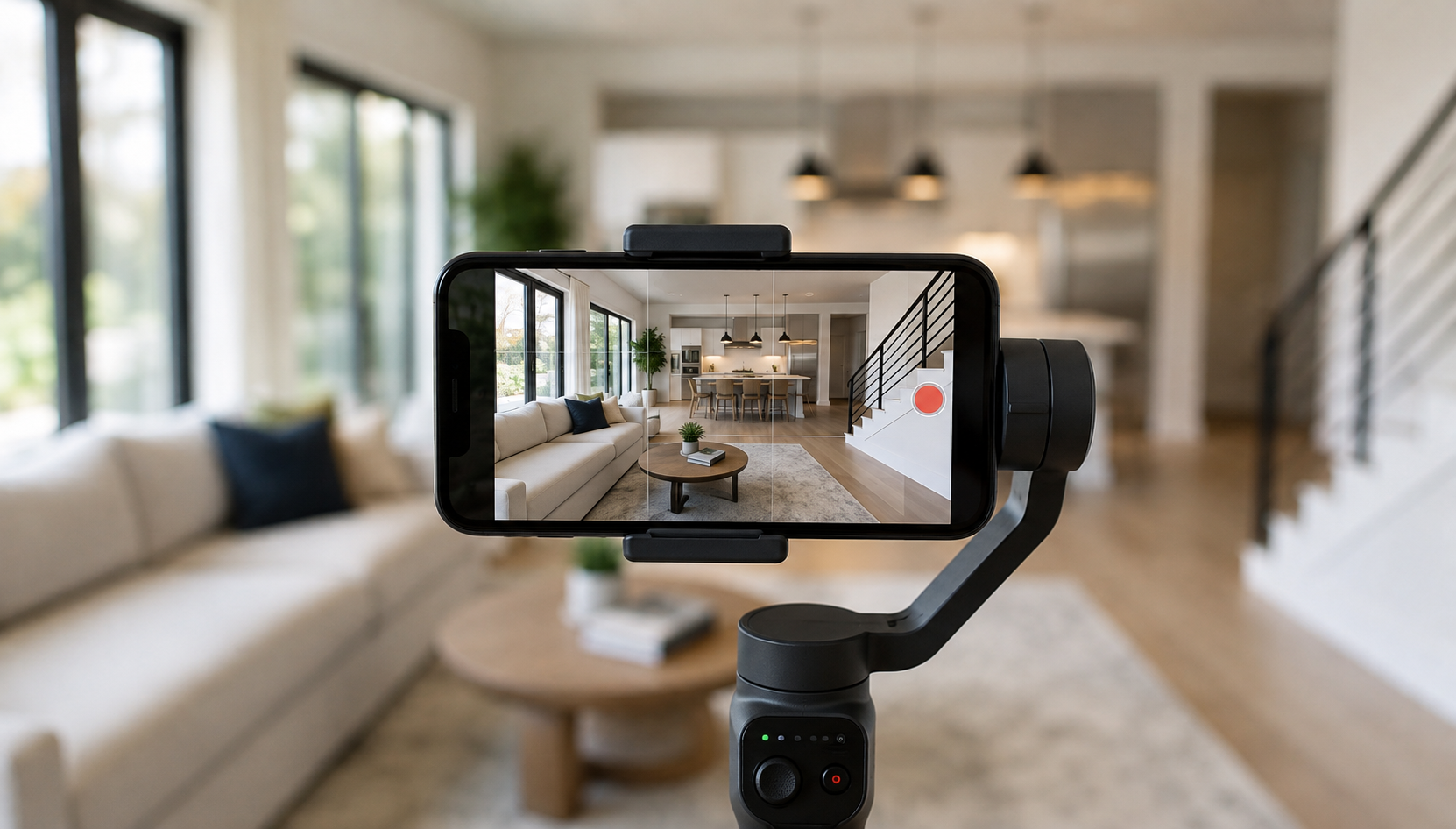
Smooth camera movement can make an ordinary property look polished, but movement without purpose can become distracting surprisingly quickly. The goal isn't to prove that the camera can glide around the room. The goal is to help the viewer understand the space.
Start by keeping movements simple. Walk forward slowly, pull back, pan gently, or move laterally to reveal a feature. Those basic movements are often more effective than complicated spins, dramatic swings, or constant motion.
Whenever possible, give the movement a reason.
Move through a doorway to reveal the room beyond it. Slide sideways past a wall to uncover the kitchen. Walk toward the windows to reveal the view. Pull backward through patio doors to show how indoor and outdoor spaces connect.
The viewer should feel as though they're discovering the property rather than being shaken around inside it.
Height matters too. Holding the camera too low can exaggerate furniture and make rooms feel strange. Holding it too high can create a detached surveillance-camera feeling. A natural eye-level perspective usually works best because it approximates how someone would experience the room in person.
Be especially careful with ultra-wide perspectives. Making a ten-foot bedroom look like an aircraft hangar may create impressive footage, but it also creates false expectations. Buyers notice the difference when they arrive in person. Trust matters more than making every room look huge.
Lighting can affect movement quality as well. Walking from a dark hallway directly toward a bright window can cause dramatic exposure changes. Plan your route so the camera can adjust naturally, or shoot the spaces separately and edit the transition.
Don't feel obligated to move in every shot. Static shots can be powerful. A beautifully framed kitchen detail or backyard scene can create a pause between more dynamic clips.
Variety gives the video texture.
The best test is simple: watch the footage and ignore the house for a moment. Does the camera movement make you aware of the camera itself? If so, it may be too complicated.
Good movement disappears into the experience.
The viewer should be thinking about the property, not wondering how you filmed it.
Make Audio and Voiceover Work as Hard as the Visuals
Real estate video is often treated as a purely visual medium, but audio can determine whether a property tour feels generic or genuinely engaging.
A thoughtful voiceover gives you something the camera cannot: interpretation.
The footage can show a kitchen island. Your voice can explain that it seats four people without blocking the cooking area. The footage can show a backyard. Your voice can explain that the patio stays shaded during part of the afternoon. The footage can show an upstairs landing. Your voice can tell the viewer that the space is large enough for a small desk.
Those details turn images into information.
Avoid narrating exactly what viewers can already see. If the video clearly shows a bathroom, saying, "And here is the bathroom," wastes the opportunity. Tell them something they wouldn't know from the picture.
You can also use voiceover to acknowledge tradeoffs. "The secondary bedrooms aren't huge, but both have surprisingly good closet space." A sentence like that builds credibility because it sounds like someone evaluating the property rather than reading promotional copy.
Keep the delivery conversational. Imagine you're walking through the home with one interested buyer, not presenting to a stadium.
Natural pauses help. So does variation in emphasis. A perfectly polished announcer voice isn't necessary, and sometimes it can actually make the content feel less personal.
Background music can support the mood, but it should never fight with the narration. If people have to concentrate to hear you, the audio mix is wrong.
Natural sound can also add life. The subtle sound of a door opening, footsteps on a patio, or outdoor ambience can make the video feel more immersive. You don't need to use natural sound constantly, but a few moments can make the property feel less like a slideshow.
Always assume that some viewers will watch without sound. That means your video should still make sense visually and through limited text.
The strongest approach is layered: visuals create interest, voiceover adds interpretation, text reinforces key details, and music supports rhythm.
When those elements work together, viewers don't just see a property. They understand why the property matters.
Use On-Screen Text Without Turning the Video Into a Presentation
Text can be incredibly useful in real estate videos because it helps viewers understand the message immediately, especially when they're watching silently. The problem starts when the screen becomes crowded with so much information that the video feels like a moving brochure.
Use on-screen text for the things that matter most.
Your opening hook is one obvious place. A simple phrase such as "The backyard is bigger than you'd expect" immediately establishes the video's purpose.
You can also use text to identify key facts: bedroom count, approximate size, notable renovation, price range, or neighborhood context. But don't dump everything onto the screen at once.
Think in short visual sentences.
If someone has to stop the video to read a paragraph, the text is too long.
Location matters too. Avoid placing important words directly over busy cabinets, patterned tile, bright windows, or moving backgrounds where readability becomes difficult. Clean areas of the frame give text room to breathe.
Consistency helps the video feel intentional. Use the same general text style, placement logic, and hierarchy throughout the piece. You don't need multiple fonts, animated effects, flashing colors, and constantly changing sizes.
Simple almost always looks more professional.
Text can also create mini open loops. You might show "Feature #2 is easy to miss" just before revealing a storage area or hidden pantry. That's a small storytelling device that gives the viewer a reason to stay for another few seconds.
Captions are valuable when you're speaking on camera or using voiceover. Many viewers initially watch silently, and readable captions allow them to follow your explanation without turning the sound on.
Don't try to make text do the job of good footage. If you're spending half the video explaining the layout in words, the visuals may not be communicating clearly enough.
The screen should feel like a window into the property, not a spreadsheet.
Use text as a guide.
Point the viewer toward the important thing, give them enough context to understand it, and then let the home itself do the rest of the work.
Put a Human Presence Into the Video
People connect with people faster than they connect with empty rooms.
That doesn't mean every real estate video needs a presenter standing in the kitchen and delivering a formal introduction. Human presence can be subtle. A hand opening a door, someone walking onto the patio, a person sitting briefly at the island, or a voice behind the camera can make the property feel more alive.
Scale is one major reason this works.
A room can look completely different once a person stands inside it. Suddenly, viewers understand the height of the ceiling, the width of the hallway, the size of the patio, or how much room exists around the kitchen island.
Human presence also gives you opportunities to create transitions. Walk toward the front door and cut to the interior as it opens. Step through the kitchen and continue onto the patio. Sit at the built-in desk and briefly explain why the area functions well for remote work.
If you're comfortable appearing on camera, your presence can add trust and personality. Don't turn every clip into a speech. Short appearances often work better.
You might open with, "There's one thing about this house I didn't understand until I walked through it," then move immediately into footage.
Later, return for a ten-second explanation of a key feature.
This breaks visual monotony and creates a sense of conversation.
Your body language should match the tone. If you're filming a quiet historic home, extremely energetic movement may feel out of place. If you're presenting a bright modern property designed for entertaining, a more upbeat style may make sense.
Avoid overperforming. Buyers can usually tell when excitement is being manufactured. You don't have to describe every pantry as amazing or every bedroom as stunning.
Sometimes, "This is the part I'd want to see in person" is more persuasive than a pile of superlatives.
A human presence is valuable because real estate is ultimately personal. The building matters, but viewers also want guidance from someone who can help them notice what matters.
Your role in the video is not to compete with the property.
It's to help the viewer experience it.
Match the Video Format to the Buyer's Stage of Interest
Not every viewer needs the same video because not every viewer is at the same stage of interest.
Someone casually scrolling through neighborhood content needs a different experience from a buyer who has already opened the full listing three times and is considering scheduling a showing.
This is where a lot of real estate video strategies become more effective: instead of trying to create one perfect video, create different videos for different levels of intent.
At the top of the funnel, keep things quick and curiosity-driven. A twenty- or thirty-second video might focus on the strongest feature, a surprising price comparison, or the lifestyle around the property. The goal is not to explain everything. The goal is to get someone interested enough to investigate further.
For viewers showing more serious interest, create a deeper property walkthrough. Spend more time on layout, storage, bedroom sizes, renovation details, outdoor space, parking, and practical features.
You can also create problem-solving videos. If buyers repeatedly ask whether the downstairs space could function as an office, make a short video showing exactly how it might work.
Another format can focus entirely on the neighborhood. Instead of showing ten rooms, show what a typical ten-minute radius around the property looks like.
The same listing might generate five or six genuinely different videos.
That's not excessive if each one serves a different purpose.
Think of the content journey as layers. The first video earns attention. The second builds interest. The third answers questions. The longer walkthrough helps someone evaluate. The follow-up video removes uncertainty.
You don't need every viewer to watch every layer. You want the right people to naturally move deeper.
This approach also takes pressure off individual videos. Your short clip doesn't have to contain every piece of property information because its job is simply to create curiosity.
Once you understand the viewer's stage, editing becomes much easier.
Ask, "What does this person need next?"
Then create that video.
End With a Call to Action People Actually Want to Follow
A surprising number of strong videos become awkward during the final five seconds.
The property looks great, the pacing works, the viewer stays interested—and then the video ends with a generic command such as "Contact me today!"
There's nothing technically wrong with that, but it asks for a relatively big action without giving the viewer much context.
A better call to action feels like the natural next step in the conversation.
If the video focuses on an unusual floor plan, you might say, "Want to see the full layout? Ask for the floor plan."
If the video highlights the neighborhood, try, "Want to know what else is available within a few blocks of this property? Send me a message."
If you're showing a home where the backyard is the main attraction, you might end with, "The outdoor space is much easier to understand in person, so if this layout fits what you're looking for, schedule a walkthrough."
These calls to action are specific. The viewer understands what they'll get.
You can also create lower-pressure actions. "Save this if you're comparing homes in this area." "Share this with the person who's helping you choose." "Tell me which room you'd change first."
Those actions may not immediately generate a showing, but they create engagement and help your content travel.
Match the call to action to the level of buyer interest.
A cold viewer who watched a twenty-second neighborhood clip may not be ready to schedule a showing. Asking them to view more details makes sense.
Someone who watched a detailed two-minute tour may be much closer to taking action.
Keep the ending brief. Don't destroy good pacing with a fifteen-second sales speech.
The final moment should also visually support the message. End on a strong view of the home, backyard, kitchen, or exterior rather than an awkward freeze frame.
Your call to action doesn't need to sound clever.
It needs to sound useful.
If viewers already invested their attention by watching until the end, respect that attention by making the next step obvious, simple, and relevant.
Create a Repeatable Real Estate Video Workflow
Great property videos become much easier when you stop treating every shoot like a completely new creative project.
Build a repeatable workflow.
Before arriving at the property, identify the video's central story. Write down the hook, three key moments you need to capture, and the call to action. This five-minute exercise can save enormous amounts of editing time because you know what you're looking for.
Create a basic shot checklist, but don't let it become a prison. You might always capture the exterior, entry, main living space, kitchen, primary bedroom, strongest secondary feature, outdoor space, and one detail shot. Then add property-specific footage based on the story.
Shoot more vertical clips than you think you'll need. A five-second clip of sunlight moving across a countertop may not feel important during the shoot, but it could become the perfect transition later.
Capture several versions of important shots. Walk into the kitchen once. Then try a slow lateral move. Then record a static wide view. Choices make editing easier.
If you're planning voiceover, record rough notes immediately after walking through the home. Your impressions are freshest at that moment. What surprised you? What felt bigger than expected? Which feature seemed weaker online but stronger in person?
Those observations make natural narration.
Organize the footage by property so you can reuse it later. One listing may eventually become a short teaser, a neighborhood video, a full walkthrough, an FAQ clip, a seller case study, and an educational post.
When editing, start by building the story without worrying about effects. Hook, proof, progression, payoff, action.
Then tighten the pacing.
Then add text.
Then handle audio.
Effects come last, if you need them at all.
This workflow keeps production focused on communication rather than decoration.
Over time, you'll also learn your own patterns. Maybe kitchen-to-patio transitions consistently hold attention. Perhaps neighborhood openings outperform exterior shots. Maybe buyers respond especially well when you explain one honest tradeoff.
Use those lessons.
A repeatable workflow doesn't make your content robotic. It removes unnecessary decisions so you can spend more energy on the part that should remain unique: the story of the property itself.
Conclusion
Creating real estate videos buyers actually watch until the end has much less to do with flashy production than most people assume. It comes down to respecting attention.
Don't make viewers wait for the interesting part.
Don't show every room simply because the room exists.
Don't confuse beautiful footage with useful storytelling.
Start by identifying what the right buyer would care about most. Then build the entire video around that idea. Give the opening a specific hook. Use the footage to prove your point. Show what living in the property could actually feel like. Keep the pacing moving, but give important spaces enough time to register.
Use camera movement intentionally rather than constantly. Add voiceover when explanation makes the visuals more valuable. Keep text simple. Bring a human presence into the video when it helps establish scale, trust, or personality.
Most importantly, stop expecting one video to do every job.
A quick teaser can generate curiosity. A lifestyle video can create emotional interest. A deeper walkthrough can help serious buyers evaluate the property. An FAQ video can remove friction. A neighborhood clip can attract someone who wasn't even looking at the listing yet.
That's how real estate video becomes a system rather than a one-time property tour.
When you're editing, imagine a viewer constantly asking one question: "Why should I keep watching?"
Every few seconds, answer it.
Give them a useful detail.
Reveal something.
Change the visual perspective.
Explain why a feature matters.
Move to the next part of the story.
If the viewer already knows exactly what's coming for the next twenty seconds, you've probably lost them.
The best real estate videos don't feel like someone slowly documenting a building. They feel like someone knowledgeable is showing you exactly what matters and skipping what doesn't.
That's the experience buyers will stay for.
And when they reach the end, they'll be far more likely to remember the property—and take the next step.
Vídeos imobiliários, simplificados.
Subscrever