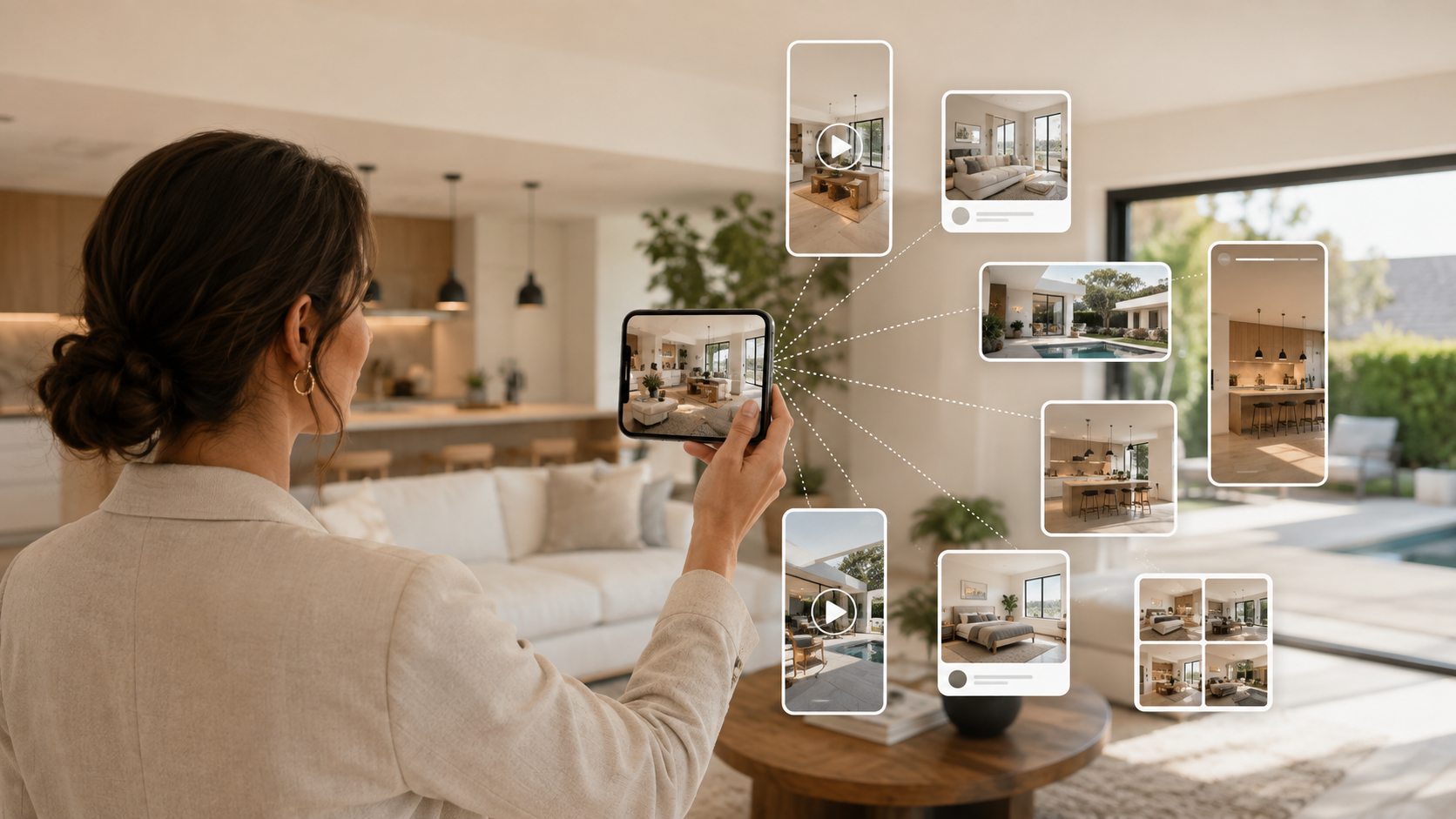
How to Turn One Property Listing Into 10 Pieces of Content
Published:
August 19, 2026
A new property hits the market, the photos come back, the description gets written, and the listing goes live. Then what happens? In a lot of real estate marketing, the agent posts the property once, maybe shares a quick video a few days later, and moves on. That approach leaves an incredible amount of usable content sitting on the table. A single property listing isn't just a sales page. It's a collection of stories, visuals, questions, lifestyle angles, educational opportunities, and buyer conversations waiting to be turned into marketing material.
Think about everything packed inside one listing. You have architecture, location, design choices, pricing, amenities, neighborhood features, buyer objections, financing questions, seller decisions, photography, staging, and the emotional idea of what it might feel like to live there. That's already far more material than one "Just Listed" post can possibly communicate. When you approach a property as a content source instead of a one-time announcement, your marketing immediately becomes easier because you're no longer constantly staring at a blank screen wondering what to post.
The goal isn't to repeat the same sales pitch ten times. That's the mistake people make when they hear the word repurposing. Real content repurposing means changing the angle, format, audience, or purpose while keeping the same property as the raw material. One post may highlight design. Another may educate first-time buyers. A third may focus completely on the neighborhood. Someone could see all three without feeling like they're being shown the same advertisement again and again.
This is especially useful when you want to stay visible without creating completely new ideas every morning. Instead of chasing endless inspiration, you build a small content ecosystem around something you already know well. Here's how to take one property listing and turn it into 10 genuinely different pieces of content that feel natural, useful, and worth paying attention to.
Why One Listing Should Never Be Just One Post
The traditional way of marketing a property is surprisingly wasteful. You invest time arranging photography, preparing the home, gathering details, understanding the seller's situation, researching the neighborhood, writing the listing copy, and answering questions from potential buyers. Then all that information gets compressed into a handful of photos and a caption that basically says, "Three bedrooms, two bathrooms, great location, schedule a showing." That's like cooking an entire Thanksgiving dinner and serving only the mashed potatoes.
A listing contains multiple layers of information, and different people notice different layers. One buyer may care about the oversized kitchen because they entertain every weekend. Another may barely look at the kitchen and immediately notice the fenced yard because they have two dogs. A remote worker might focus on the extra bedroom that could become an office. A parent may care more about the morning commute and nearby parks than the upgraded countertops. If you only create one piece of content, you're gambling that a single message will somehow connect with all of those people.
Multiple content pieces let you change the doorway without changing the house. The product stays the same, but the reason someone becomes interested can be completely different. That's why a kitchen-focused video may reach someone who ignored the original listing post. A neighborhood guide may introduce the property to someone who wasn't actively house hunting. An educational post about buying a renovated home may attract a person who doesn't care about "Just Listed" content at all.
There's another benefit that's easy to underestimate: familiarity. People rarely take action the first time they see something. They notice it, scroll past, see it again later, recognize it, and eventually become curious. Reusing a listing intelligently gives the property multiple chances to register without forcing you to publish the exact same advertisement.
It also strengthens your personal expertise. You're no longer simply showing inventory. You're explaining homes, interpreting neighborhoods, answering questions, and helping people think through decisions. That difference matters. A listing can sell one house, but smart content built around that listing can also attract future buyers, sellers, referrals, and conversations long after the original property disappears from the market.
Start With a Strong Core Property Story
Before turning one listing into ten pieces of content, figure out what the property is actually about. Not the square footage. Not the bedroom count. Not the bullet-point features. Those details matter, but they aren't the story. The story is the reason someone would remember this home after scrolling through twenty others.
Start by asking a simple question: What is the most interesting thing about living here? Maybe the property has an unusually private backyard in a busy neighborhood. Maybe it has a layout that's perfect for someone working from home. Maybe it's an older house with character but a completely modern interior. Maybe the strongest selling point isn't the house at all, but the ability to walk to coffee shops, restaurants, parks, and everyday errands.
Once you identify that central idea, content creation becomes much easier. You can still talk about ten different subjects, but they all feel connected. Imagine a townhouse where the main appeal is low-maintenance urban living. Your video might show a morning routine that starts with coffee on the balcony. Your neighborhood post might map out places within walking distance. Your educational piece might explain what buyers should check when evaluating homeowners association fees. Your email might describe why the property works well for someone who wants convenience without maintaining a large yard. Different pieces, one clear identity.
It helps to build a quick content source sheet before publishing anything. Write down the property's top five physical features, three emotional benefits, five common buyer questions, three neighborhood advantages, two possible objections, and one surprising detail. Add any useful stories from the preparation process. Did the seller transform an awkward room into a beautiful office? Was the backyard designed specifically for entertaining? Does the morning light dramatically change the living room?
This becomes your raw material. Instead of inventing content, you're extracting it.
Strong property marketing often works the same way good storytelling works: specific details create interest. "Beautiful home in a great location" disappears instantly. "A kitchen where twelve people can gather without blocking the person cooking" gives someone an image they can actually imagine.
Content Piece #1: Create a High-Impact Listing Spotlight
Your first piece can still be the classic property announcement, but it should do more than repeat the listing description. A strong listing spotlight introduces the property in a way that gives people an immediate reason to care. You want someone who isn't actively searching real estate listings to stop because the opening makes the home feel interesting.
Instead of leading with numbers, lead with the strongest emotional or practical advantage. "If you've been looking for a house where the backyard feels like an extra living room, this one deserves a look" creates more curiosity than starting with the number of bedrooms. You can bring in the specifications immediately afterward, but the hook gives the reader a reason to keep going.
The spotlight should focus on three or four memorable features, not everything the house contains. When every feature is described as special, nothing feels special. Choose the elements that shape the experience of the property. Maybe that's the open kitchen, covered patio, primary suite, and location near a popular district. Give each feature enough context to show why it matters. Don't simply say "large kitchen island." Explain that it creates a place for breakfast, homework, casual dinners, and friends hanging out while someone cooks.
Photos should follow the same principle. Your opening image needs to communicate the strongest visual promise of the property. Sometimes that's the exterior. Often it isn't. If the kitchen or backyard is dramatically more appealing, start there. Marketing isn't a mandatory architectural tour where the front door has to come first.
The final call to action can also sound natural rather than overly sales-heavy. Invite questions about the property, neighborhood, price range, or showing availability. The objective isn't simply "book now." Engagement gives you useful information about what people find interesting, and those questions can become later pieces of content.
This first post becomes the anchor. Every other piece in your ten-part strategy can zoom in on an element that the spotlight introduced but didn't have room to explore.
Content Piece #2: Turn the Property Into a Short-Form Video
Short-form video works best when it has a point. A random collection of room clips set to music may technically show the property, but it doesn't necessarily create a reason to keep watching. Your listing already gives you the visuals; what you need is a concept that turns those visuals into a miniature story.
One easy approach is the three-reasons format. Open with something like, "Three things you wouldn't expect from this home," and then show the details one by one. Perhaps it's the amount of backyard privacy, an unexpectedly large pantry, and a finished flex space downstairs. The structure creates anticipation because viewers know something else is coming.
Another option is to build the video around a specific buyer experience. "What mornings could look like in this house" lets you show light coming through the kitchen, coffee on the patio, the home office, and the quiet street outside. You aren't pretending someone already lives there; you're helping potential buyers visualize the lifestyle the floor plan supports.
Avoid trying to show every room. A forty-second video with fifteen rapid clips often becomes visual noise. Pick one angle and make the footage support it. If you're talking about entertaining, show the kitchen, dining space, patio, guest parking, and backyard. If you're talking about remote work, show the office options, natural light, storage, and quiet corners.
Voiceover can add far more personality than text overlays alone. Explain what surprised you, what you think buyers might overlook, or why a feature works better in person than it appears in photographs. That kind of commentary feels less like advertising and more like someone knowledgeable giving you a personal tour.
One property can eventually produce several videos, but this first one should introduce the biggest visual story. Keep it focused. The best property videos don't feel like someone dragging you through every doorway. They feel like a friend saying, "You've got to see this part."
Content Piece #3: Build a Photo Carousel Around a Buyer Journey
A photo carousel becomes much more effective when the images are arranged intentionally instead of simply uploading the photographer's favorite shots. Think of the slides as pages in a short visual story. Each image should answer a question or create a reason to move to the next one.
Start with a clear promise. The first slide might say, "What $650,000 looks like in this neighborhood" or "A closer look at the spaces buyers keep asking about." That tells people exactly why they should swipe. The next slides can reveal the property in an order that mirrors how someone might experience it.
Suppose the home is designed for entertaining. Slide one introduces the idea. Slide two shows the kitchen and mentions seating around the island. Slide three shows the dining area and explains how it connects naturally to the living room. Slide four moves outside to the patio. Slide five highlights the backyard. The final slide can show a floor plan or exterior with a simple invitation to ask for details.
You can also use carousels to address objections. Maybe people assume a smaller home will feel cramped. Create a sequence showing how storage, open sight lines, multifunctional rooms, and outdoor space make the property live larger than its square footage suggests. That's far more persuasive than saying, "This home feels spacious."
The writing on each slide should be short, but the caption can add deeper context. Explain what people are seeing and why it matters. If a room has recently been renovated, mention the updates. If the layout is unusual, explain how previous owners used it effectively.
Carousels are particularly useful because they encourage slower consumption. Someone who might watch five seconds of a video may spend thirty seconds moving through images. That gives you more opportunities to communicate.
Most importantly, the carousel should have a single theme. Don't try to recreate the entire listing page. You're creating an editorial experience around the property, not stuffing a brochure into ten slides.
Content Piece #4: Create a Neighborhood Lifestyle Feature
A house doesn't exist in a vacuum. Buyers aren't only choosing four walls and a roof; they're choosing their commute, grocery run, weekend routine, favorite coffee stop, walking route, and the amount of time they'll spend getting to places they care about. That's why one of the strongest pieces of content you can create from a listing may barely show the home itself.
Build a neighborhood lifestyle feature around the question, "What is it actually like to live here?" Walk or drive through the surrounding area and identify the places that shape daily life. Parks, trails, cafes, schools, grocery stores, local restaurants, gyms, transit options, business districts, waterfront areas, and major roads can all become part of the story.
Keep the information specific. "Close to restaurants" doesn't tell someone much. "You can reach several casual dinner spots within roughly ten minutes" gives people a practical sense of convenience. If something is walkable, be accurate instead of stretching the definition. People remember when real estate descriptions promise an easy stroll that turns out to be a twenty-five-minute hike beside a six-lane road.
You can format this piece as a written post, a narrated neighborhood video, or a photo series. The key is making the listing the starting point rather than the entire subject. For example, you might say, "The backyard gets plenty of attention, but one of the biggest advantages of this property is what sits just outside the neighborhood."
This content reaches a different audience from a normal property tour. Some people become interested in neighborhoods before they become interested in specific homes. Someone may save your local guide even if this particular listing isn't right for them. Six months later, when they're ready to buy nearby, they already associate you with useful knowledge about the area.
That's the larger advantage of content repurposing. Some pieces market the listing directly. Others use the listing to demonstrate the kind of expertise people may need later.
Content Piece #5: Write an Educational Buyer Post
Every property creates questions, and those questions can become educational content. The trick is to identify a feature or situation that applies beyond the individual listing. That allows you to talk about the home while giving readers information they can use in their broader search.
Imagine the property has an older roof but a beautifully updated interior. Instead of avoiding the subject, you could create a post about what buyers should evaluate when purchasing a renovated older home. Use the listing as an example while explaining the difference between cosmetic improvements and major systems. Discuss questions buyers might want to ask about the roof, electrical system, plumbing, heating and cooling equipment, permits, windows, or previous work.
If the property has a homeowners association, you could explain what buyers should review before purchasing in a managed community. If the listing includes a finished basement, discuss how buyers can investigate whether finished space is permitted and how it may be represented in square footage. If there is a large lot, explain common questions about fences, setbacks, easements, or future additions while reminding readers that specific requirements depend on local rules.
Educational content works because it shifts the relationship. You're no longer asking someone to admire a house. You're helping them make better decisions.
This kind of post also gives you a reason to speak with more nuance. Real estate is full of tradeoffs. An older home may offer character and location while requiring more maintenance. A condo may reduce exterior responsibilities while adding monthly fees and community rules. A large yard sounds wonderful until someone realizes they don't want to spend Saturdays maintaining it.
Use the actual listing as the spark, but make the lesson bigger than the listing. People are more likely to save educational posts because they expect to need the information later. That means your property may continue generating attention even among buyers who never schedule a showing.
Content Piece #6: Share a Behind-the-Scenes Story
People see the polished listing photos, but they rarely see everything that happened before those photos existed. That's exactly why behind-the-scenes content can be so engaging. It reveals the work, decision-making, and small details that turn a property into something ready for the market.
You might show how furniture was repositioned to improve flow, why certain rooms were photographed at a particular time of day, or how a seller prepared the house during the week before launch. Maybe a dark guest room became a bright home office with a few simple changes. Maybe the photographer waited until late afternoon because the backyard light looked dramatically better. Maybe the entryway seemed crowded until one piece of furniture was removed.
These details make strong content because they're real. You aren't inventing another generic tip. You're telling a story that happened around an actual property.
Behind-the-scenes posts can also communicate your expertise without saying, "I'm an expert." Showing how you think is much more convincing than giving yourself a label. If you explain why removing oversized furniture made the living room easier to understand in photographs, people see that you understand presentation. If you describe why the launch date was chosen to coordinate photography, preparation, and showing availability, they see there is a strategy behind the listing.
The tone matters. Keep the story respectful to the seller and avoid revealing private information, financial stress, personal circumstances, security details, or anything the owner hasn't agreed to share. The interesting part should be the marketing process, not someone's private life.
A simple before-and-after concept works especially well. Show what changed, explain why, and connect the change to how buyers experience the home.
This type of content gives a property more personality because it reminds viewers that real people prepared it. It also speaks quietly to future sellers who may be wondering what working with a knowledgeable professional actually looks like.
Content Piece #7: Turn Property Features Into FAQ Content
Questions are one of the most reliable sources of content because they come directly from what buyers want to know. Once a listing starts receiving inquiries, pay attention to repetition. If three people ask whether the basement is finished, whether the yard is fenced, or how far the home is from a major commuter route, you don't just have questions. You have content ideas.
Create a property FAQ post that answers the most useful questions clearly. This can be written as a single long caption, a series of slides, or a video where each question appears on screen before you answer it. The format matters less than the clarity.
Don't limit yourself to factual questions already printed in the listing. Buyers often want context. "How private is the backyard?" "Could the downstairs room work as a bedroom?" "Where would guests park?" "How much natural light does the living room get in the afternoon?" These are questions that photographs may not answer properly.
You can also address the small uncertainties that stop people from scheduling a showing. Someone may like the property but assume the home office is too small. A quick video showing a desk, chair, and shelving setup can solve that concern. Someone might think the yard requires extensive maintenance until you explain how much of it is already landscaped.
Be careful not to speculate about things you can't verify. If a question involves zoning, future development, school assignments, legal use, taxes, or other details that can change, direct people toward the appropriate official source instead of making casual promises.
FAQ content feels useful because it mirrors a conversation rather than an advertisement. It also helps you work efficiently. Instead of answering the same basic question individually twenty times, you create one strong explanation and make it available publicly.
Even after the property sells, the general questions can be repurposed again. "What buyers asked most about this home" can become a surprisingly good educational post about how people evaluate properties in that particular market.
Content Piece #8: Create a “Who Is This Home For?” Post
One of the best ways to make a property more memorable is to stop describing the building for a moment and describe the person who might enjoy living there. You're not talking about protected demographic characteristics or deciding who should be allowed to live somewhere. You're talking about lifestyle fit: the habits, priorities, space needs, and routines that the property supports particularly well.
Maybe the home is ideal for someone who loves hosting dinner because the kitchen and living space connect directly to a large patio. Perhaps it's a strong fit for someone who works remotely and wants two possible office spaces. A low-maintenance townhome might appeal to someone who wants to travel frequently without worrying about a large yard. A house near trails might work beautifully for someone who spends weekends hiking, biking, or running outdoors.
The post can begin with something conversational: "You'd probably love this house if..." Then describe three or four situations that match the property honestly.
This framing works because buyers naturally evaluate homes through imagined routines. They're rarely thinking only in dimensions. They're imagining where the Christmas tree might go, whether two people can get ready in the morning without colliding, where the dog would sleep, whether friends could gather around the kitchen, and whether a home office would feel separated from evening life.
Specificity gives the content energy. "Great for entertaining" is vague. "The kitchen opens directly into the dining area and covered patio, so people can spread out without disappearing into separate rooms" paints a scene.
This type of post can also reveal who might not love the property. You don't need to criticize the listing, but acknowledging tradeoffs builds credibility. A large garden might delight someone who enjoys yard work and feel like a burden to someone who wants minimal upkeep.
Good real estate content doesn't try to convince every person that every house is perfect. It helps the right person recognize when a particular property aligns with the way they actually live.
Content Piece #9: Build an Email Story Around the Listing
Email gives you more room than a quick social post, which means you can tell a more complete story about the property without rushing. Instead of opening with "New listing available," begin with something that creates curiosity. Maybe it's a surprising feature, a problem the house solves, or a moment you experienced while preparing it for market.
For example, you might write about stepping into the backyard for the first time and realizing how quiet it feels despite the convenient location. Then connect that observation to the people who might appreciate the property: someone who wants easy access to city amenities but doesn't want to hear traffic every evening.
The email doesn't need to become a giant sales brochure. In fact, it usually works better when you focus on one compelling idea and provide a simple link or invitation for the full details. You could spotlight the floor plan, neighborhood, renovation, outdoor space, or price positioning.
Try writing the email as though you're telling a friend why the home caught your attention. That naturally produces more readable language. "The photos show the kitchen well, but what they don't really capture is how the entire main floor connects when the doors to the patio are open" feels more human than a paragraph loaded with adjectives such as stunning, gorgeous, luxurious, and incredible.
You can segment the message mentally around reader needs. Buyers may care about the opportunity itself. Homeowners may be curious about pricing and presentation. People casually following the market may be interested in what a certain budget currently buys. One listing can speak to all three when you give readers context.
The email can also generate future content. Questions and replies tell you what readers noticed. If several people ask about price, location, or renovations, those subjects can become separate posts.
A good listing email isn't simply distribution. It's another opportunity to turn the property into a useful conversation.
Content Piece #10: Repurpose the Listing Into Evergreen Market Content
The biggest missed opportunity happens when a listing closes and the content disappears with it. A sold property may no longer need active promotion, but it can still teach your audience something valuable. This is where listing-based content becomes evergreen market content.
Suppose the property received multiple offers. You can create a post explaining what features appeared to generate the strongest buyer interest, without revealing confidential details. Perhaps outdoor space mattered more than expected. Maybe buyers repeatedly commented on the renovated kitchen or flexible home office. That observation can become broader guidance for homeowners preparing to sell.
If the home took longer to sell, there may still be useful lessons. You could discuss how pricing adjustments affect attention, why presentation matters, or how market conditions can influence the pace of a sale. Keep the tone educational rather than defensive. Every property tells you something about how buyers are responding.
You can also turn the listing into a market comparison. "What this budget bought in this neighborhood" remains useful even after closing because people are constantly trying to understand value. Several months later, you can compare similar properties and show how available options have changed.
Photos can be reused carefully where you have the appropriate rights and permissions. A kitchen image may support an article about renovation trends. A floor plan may help explain layout considerations. A backyard photo may illustrate outdoor features buyers frequently prioritize.
Evergreen content extends the life of your marketing investment. Instead of thinking of professional photographs and property research as assets that expire the moment the contract closes, think of them as a library.
Over time, that library becomes incredibly valuable. Ten listings can potentially generate one hundred pieces of content. Fifty listings can create hundreds of examples, stories, answers, visuals, and market insights. At that point, content creation stops feeling like an endless demand for new ideas because your everyday work is producing the ideas for you.
How to Organize the 10 Pieces Into a Simple Content Schedule
Creating ten pieces of content doesn't mean posting ten versions of the property in two days. That would exhaust your audience and probably make the listing feel less interesting rather than more. The goal is to spread the angles across the life of the listing so each piece feels fresh.
Start with the main listing spotlight when the property launches. A day or two later, publish the short-form video. The next post could shift away from the direct sales message and focus on the neighborhood. After that, use an educational buyer topic related to one of the property's features. Then return to the property itself with a carousel, FAQ, or behind-the-scenes story.
This creates rhythm. Direct promotion is followed by education or lifestyle content, which prevents your feed from feeling like a nonstop classified section.
A simple sequence could look like this:
- Listing spotlight
- Short-form video
- Neighborhood feature
- Educational buyer post
- Photo carousel
- Behind-the-scenes story
- FAQ content
- "Who is this home for?" post
- Listing email
- Evergreen market lesson
You don't need to publish them in exactly that order. Let real activity guide you. If buyers immediately start asking about the backyard, create the FAQ sooner. If a neighborhood event is happening that weekend, move the lifestyle content forward. If you receive an interesting question during a showing, turn it into a post while the idea is fresh.
Keep a simple folder for every listing containing original photos, vertical video clips, property facts, approved descriptions, common questions, and your content ideas. This eliminates the annoying process of searching through texts, emails, and camera rolls every time you want to publish something.
The larger habit is what matters: capture once, reuse intelligently. When you're already at the property for photography, shoot extra vertical video. When you're researching the neighborhood, save useful notes. When buyers ask questions, write them down. Every part of the listing process can feed your content pipeline if you deliberately collect material instead of trying to recreate it later.
Conclusion
One property listing can do much more than advertise one home. Treated strategically, it becomes a miniature content studio filled with visuals, stories, questions, education, neighborhood information, buyer psychology, and market insight. The difference isn't having a bigger marketing budget. It's learning to recognize how many different ideas are already hiding inside the work you're doing.
The easiest place to begin is with the rule that one listing should never equal one post. Introduce the home with a strong listing spotlight, then change the angle. Show it through video. Explore it through a carousel. Step outside and talk about the neighborhood. Teach buyers something connected to the property. Share a behind-the-scenes decision. Answer the questions people keep asking. Describe the lifestyles the floor plan supports. Tell a deeper story through email. Finally, after the transaction moves forward, turn what you learned into evergreen market content.
Notice what's happening there: you're not stretching one advertisement into ten advertisements. You're creating ten different reasons for people to pay attention.
That distinction is everything.
It also makes content creation dramatically more sustainable. You don't need a brilliant new idea every morning. Your listings, showings, conversations, neighborhood observations, and client questions are already producing raw material. The job is simply to capture it and give each idea the right format.
If you're working with several properties throughout the year, the effect compounds quickly. Every listing adds new visuals, new questions, new examples, and new stories to your content library. Eventually, you're no longer wondering what to post. You're deciding which of the many ideas you've collected deserves to be published next.
That's the point where content marketing stops feeling like an extra chore attached to real estate and starts becoming a natural extension of the work itself.
Real estate videos, made simple.
Subscribe