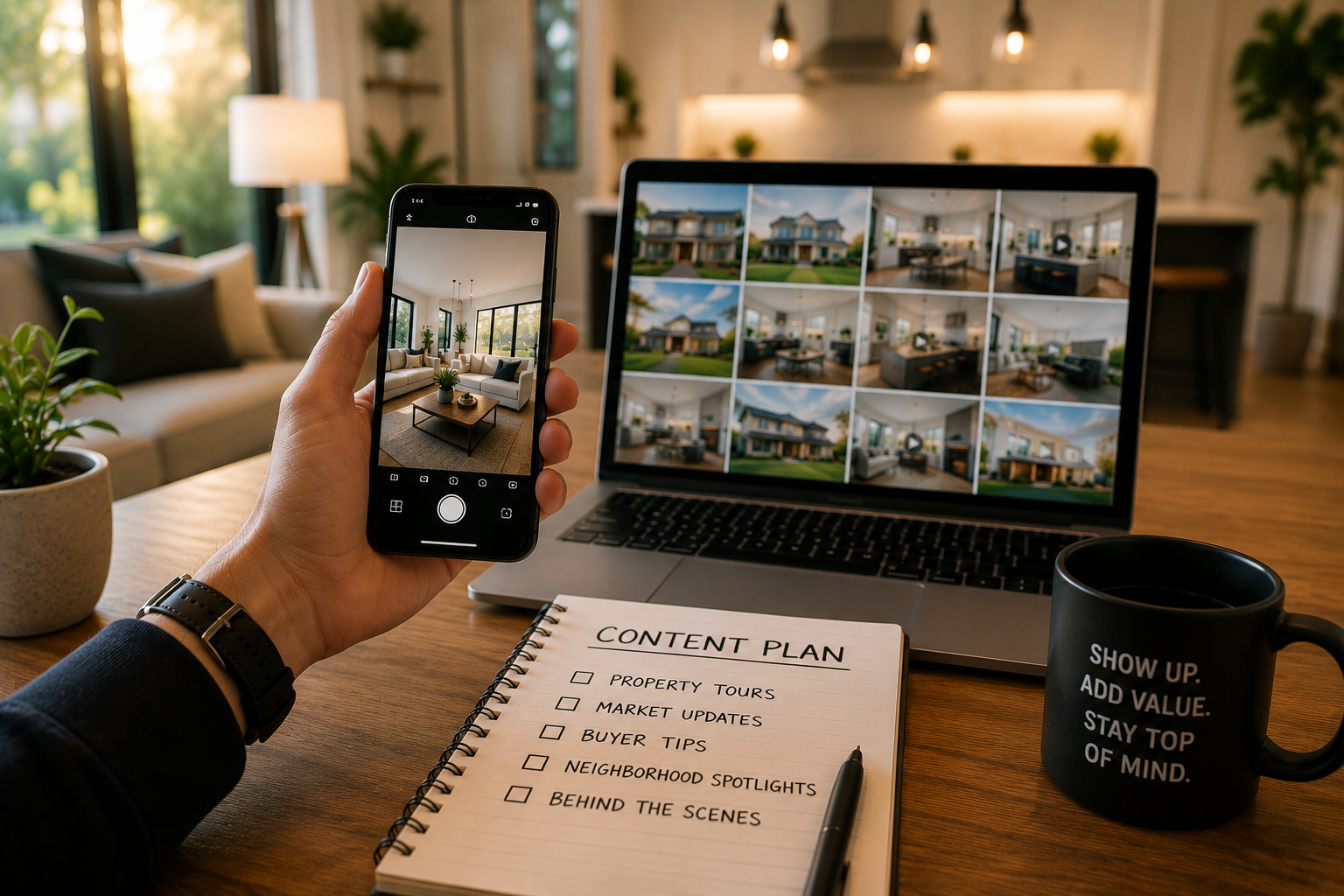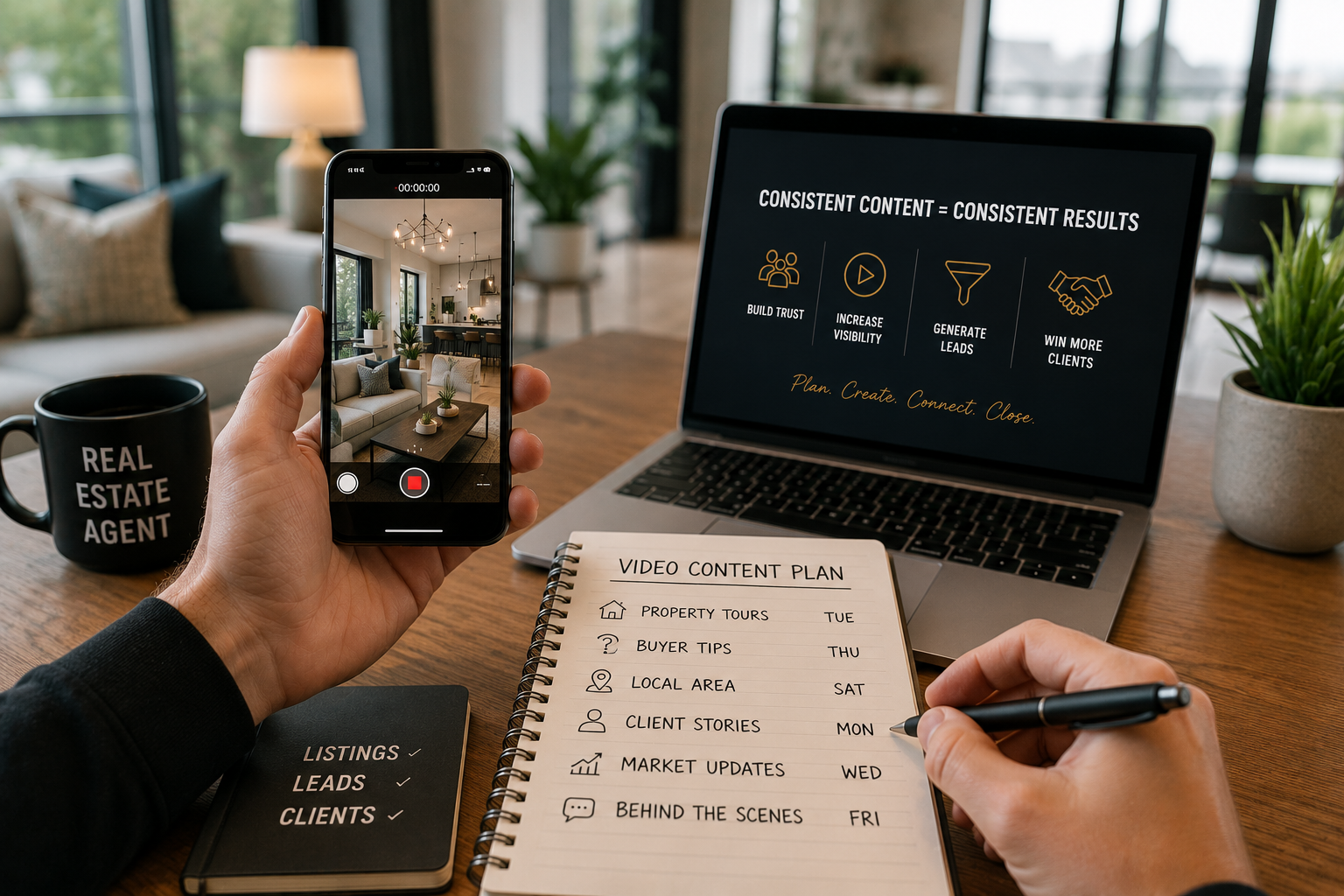
Why Every Real Estate Agent Needs a Video Content Plan
Published:
July 20, 2026
Real estate has always been a people business, but the way people decide whom to trust has changed dramatically. Years ago, a potential client might have met you at an open house, noticed your sign in the neighborhood, or received your name from a friend. Those moments still matter, yet many buyers and sellers now form an opinion about an agent long before they make direct contact. They look for useful information, observe how clearly the agent communicates, and quietly ask themselves, “Does this person understand what I need?” A thoughtful video content plan gives you a chance to answer that question before the first phone call ever happens.
The key word here is “plan.” Simply recording a property walk-through once every few months is not the same as building a dependable video presence. Random videos may create short bursts of attention, but they rarely produce consistent recognition or trust. A plan connects your ideas, your audience, your schedule, and your business goals. It helps you decide what to say, whom you are speaking to, when to publish, and how each video supports the next step in a potential client’s journey. Instead of staring at a camera and wondering what to talk about, you begin with a clear purpose.
You do not need to become an entertainer, a filmmaker, or an online celebrity. You need to become useful, familiar, and easy to understand. Think of video as a digital version of the conversations you already have every day. You explain pricing to sellers, help nervous buyers understand inspections, describe neighborhood differences, and answer questions about timing. Those conversations are already valuable content. A video plan simply helps you capture that knowledge and share it consistently.
When done well, video can make your marketing feel less like advertising and more like a helpful introduction. People hear your voice, see your mannerisms, and understand how you explain complicated decisions. By the time they contact you, they may already feel as though they know you. That familiarity shortens the distance between being a stranger and becoming a trusted adviser, which is exactly why every serious real estate agent needs a video content plan.
The Real Reason Video Matters in Real Estate
Real estate decisions are emotional, financial, and deeply personal. A person is not simply choosing a building; they may be choosing where their children will grow up, where they will spend retirement, or how they will protect years of accumulated equity. Because the stakes feel so high, clients do not select an agent based only on a polished photograph or a clever slogan. They look for signs of competence, honesty, patience, and local understanding. Video can communicate all four qualities in a way that static marketing often cannot.
A written post may show that you know the subject, but video allows people to experience how you communicate. Do you explain market conditions calmly, or do you exaggerate everything? Do you make complex ideas easier to understand, or do you hide behind technical language? Do you sound like someone who listens, or like someone who is always trying to close a deal? Viewers pick up these signals quickly, even when they cannot describe exactly what they noticed. Your tone, facial expressions, pace, and word choices all help shape their impression.
Video also gives you room to tell a fuller story. A photograph can show a bright kitchen, but a video can explain why the layout works for daily life. A short neighborhood clip can reveal the feel of a street, the distance between important places, and the rhythm of the area. An educational video can walk a seller through a pricing decision step by step. Instead of forcing people to imagine what working with you might be like, you can show them.
This does not mean every video needs to be long or complicated. Some of the most useful videos answer one specific question in plain language. The value comes from relevance and consistency, not from cinematic effects. When your videos repeatedly help people make sense of real estate, you stop looking like another person asking for attention. You begin to look like a dependable source of guidance, and that position is much more powerful than simple visibility.
Video Builds Trust Before the First Conversation
Trust usually develops through repeated contact. In everyday life, you rarely hand an important responsibility to a complete stranger after seeing one advertisement. You watch how that person behaves, listen to what they say, and decide whether their actions feel consistent. Video creates a similar process online. Each useful clip becomes a small interaction that allows potential clients to learn who you are without feeling pressured to schedule an appointment.
Imagine a homeowner who is considering a sale but is not ready to speak with an agent. They may be worried about pricing, repairs, taxes, moving dates, or the possibility that their home will sit on the market. A direct sales message may cause them to pull away because it asks for commitment too soon. A calm video explaining how to prepare for a future sale meets them where they are. It gives them information without demanding anything in return, and that creates goodwill.
The same principle applies to buyers. A first-time buyer may feel embarrassed about not understanding deposits, financing conditions, closing costs, or inspections. When you explain these topics with patience, you show that questions are welcome. Your video becomes evidence that you will not make them feel foolish during a stressful process. That emotional safety can be just as important as technical knowledge.
Consistency strengthens the effect. One video may create a positive impression, but a collection of thoughtful videos shows that your helpfulness is not accidental. Viewers begin to recognize your voice and your approach. They notice that your explanations remain clear and that you do not disappear after one week of activity. In other words, your content starts doing the early work of relationship building.
By the time someone reaches out, the conversation may feel surprisingly warm. They already know how you speak, what topics you understand, and what kind of experience you appear to offer. You are no longer beginning at zero. The trust created through video has moved the relationship several steps forward, making the first conversation more natural and productive.
Moving Images Hold Attention Better Than Static Content
People scroll quickly because they are surrounded by information. A still image may earn a glance, but movement, voice, and changing scenes create more reasons to pause. This is especially useful in real estate, where many properties and marketing messages can begin to look similar. Video provides depth. It can guide a viewer from the front entrance to the living area, reveal how rooms connect, and show details that may be difficult to understand from separate photographs.
Yet attention alone is not the goal. A loud or unusual video might stop someone briefly, but that does not mean it will produce trust or business. The real advantage of video is that it can hold attention while delivering meaning. You can use a visual example while explaining a concept, point out an important feature, or compare two possible choices. The viewer is not merely consuming information; they are following a story.
Consider a video about preparing a property for sale. A written checklist may be helpful, but a video allows you to walk through an actual space and explain why certain changes matter. You can show how crowded furniture makes a room feel smaller, demonstrate the effect of better lighting, or point out minor repairs that influence a buyer’s first impression. The advice becomes easier to remember because the viewer can connect words with images.
Video also gives your personality a place to breathe. Humor, warmth, curiosity, and empathy are difficult to communicate through a single photograph. On camera, these qualities appear naturally when you speak in your normal voice. That human element helps people stay engaged because they are listening to a person rather than reading another piece of generic marketing.
The goal is not to keep viewers watching forever. It is to earn enough attention to communicate one useful idea clearly. A planned video respects the viewer’s time, delivers something relevant, and ends with a logical next step. That combination turns attention into understanding, and understanding is what moves a potential client closer to action.
A Plan Turns Random Posting Into a Reliable System
Without a plan, video content usually depends on mood, free time, or sudden inspiration. An agent may record several clips during an energetic week, publish them quickly, and then disappear for a month because client work becomes busy. This pattern is understandable, but it makes content feel like an extra task rather than part of the business. It also prevents the audience from developing a stable expectation. People cannot become familiar with someone they rarely see.
A video content plan creates structure without removing creativity. It gives you a list of themes, a realistic schedule, and a repeatable production process. Instead of asking, “What should I post today?” you can look at your plan and see that this week includes one buyer question, one neighborhood insight, and one seller tip. The decision has already been made, which reduces mental friction and makes action easier.
The plan should connect directly to your business. If you want more listing opportunities, your videos should address the questions, fears, and decisions sellers face. If your goal is to attract buyers to a particular area, your content should explain local lifestyles, property types, pricing patterns, and common trade-offs. If you work with investors, your topics should reflect the information they actually use when evaluating opportunities. A broad audience may produce views, but a relevant audience is more likely to produce conversations.
Planning also helps you create balance. Without it, agents often talk only about new listings or recent sales. Those updates have value, but they can make every video feel like an advertisement. A thoughtful schedule mixes property content with education, community knowledge, client concerns, and behind-the-scenes explanations. This variety keeps your presence interesting while reinforcing your expertise.
Most importantly, a plan protects consistency during busy periods. Real estate rarely follows a calm, predictable schedule. Deals become complicated, clients need immediate attention, and personal responsibilities do not disappear. When your content process is simple and prepared in advance, you are less likely to abandon it completely. The plan becomes a set of rails that keeps the train moving even when the week gets messy.
Content Pillars Keep Your Message Clear
Content pillars are the main subjects your videos return to again and again. They prevent your marketing from becoming a collection of unrelated thoughts and help viewers understand what you are known for. You might choose pillars such as buyer education, seller guidance, local area knowledge, property tours, and real estate myths. Every individual video fits under one of these broader themes, making it easier to generate ideas and maintain a recognizable message.
The best pillars reflect the overlap between your expertise, your clients’ questions, and your business goals. A topic may be interesting to you, but it is not necessarily useful to the people you want to serve. Start by writing down the questions you hear during appointments, property tours, negotiations, and follow-up calls. Which concerns appear repeatedly? Which explanations seem to give clients relief? Those moments reveal what your audience genuinely wants to understand.
Suppose sellers often ask whether they should renovate before listing. That single question can produce several videos. You could discuss repairs that usually deserve attention, improvements that may not return their cost, simple ways to improve presentation, and how to prioritize work when time is limited. The pillar remains seller guidance, but the individual angles stay fresh. One real client concern becomes a small library of relevant content.
Pillars also make your brand feel consistent without forcing every video to look identical. Your clothing, location, and format can change, but the underlying value remains familiar. Viewers begin to associate you with certain kinds of helpful information. When they need guidance in that area, your name is more likely to come to mind.
Four or five pillars are usually enough. Too many can dilute your message, while too few may make the content repetitive. Each pillar should be broad enough to support many ideas but specific enough to attract the right people. Once the pillars are clear, planning becomes much less intimidating. You are no longer searching the entire world for something to say; you are choosing the next useful question inside a defined category.
A Simple Calendar Removes Daily Guesswork
A content calendar sounds formal, but it can be remarkably simple. You do not need a complicated document filled with color codes, dozens of columns, and strict deadlines. A basic monthly view with the topic, audience, format, recording date, and publishing date is often enough. The purpose is not to create administrative work. The purpose is to move decisions out of your head and place them somewhere visible.
Start with a schedule you can maintain during an unusually busy month, not the schedule you imagine following during a perfect one. Publishing one valuable video each week for a year is more powerful than publishing every day for two weeks and then stopping. Your calendar should feel slightly challenging but realistic. If it immediately creates stress, reduce the frequency and improve the consistency.
A useful approach is to assign a general purpose to each publishing slot. One week might focus on a frequently asked question, the next on a local area, the next on a seller concern, and the next on a property story. This rhythm provides variety while keeping your planning organized. You can change topics when market conditions or client needs shift, but the basic structure remains stable.
The calendar also helps you prepare. If you know you will record a neighborhood video next Thursday, you can choose the location, gather the main facts, and think about the visual examples in advance. If a seller education video is planned, you can collect questions from recent conversations. Preparation reduces the number of retakes because you are not inventing the entire message while the camera is running.
Leave some space for timely opportunities. A rigid calendar can become a cage if it prevents you from addressing an important local change or an unexpected question. Think of the plan as a map rather than a prison. It shows the direction, but you can take a useful detour when necessary. With that balance, your calendar removes daily guesswork while keeping your content responsive and human.
Video Supports Every Stage of the Client Journey
Potential clients do not move from stranger to signed agreement in a single step. They pass through several stages, even when the process happens quickly. First, they become aware of you. Then they decide whether your message is relevant, whether your knowledge seems credible, and whether contacting you feels safe. After the first conversation, they continue evaluating your professionalism and communication. Video can support every stage of this journey when each piece of content has a clear role.
Some videos are designed for discovery. These might answer broad questions, introduce a neighborhood, or explain a common real estate mistake. Their job is to help the right person find you. Other videos build consideration by showing how you think, how you solve problems, and how well you understand a particular type of client. These pieces often go deeper and speak to specific concerns.
Decision-stage videos reduce uncertainty. A seller may want to know what happens during the first consultation, how you prepare a property for launch, or how often you communicate after listing. A buyer may wonder how you organize viewings, evaluate a home, or handle negotiations. Explaining your process removes mystery, and mystery is often where anxiety grows.
Video also supports clients after they decide to work with you. You can create short educational resources that explain the next step, prepare them for common delays, or remind them what documents they need. These videos do not replace personal communication, but they reinforce it. Clients can revisit the information when they feel overwhelmed instead of trying to remember every detail from a long conversation.
A strong content plan includes videos for multiple stages rather than concentrating only on attracting attention. Views may look impressive, but attention without movement has limited business value. The better question is whether your videos help people become informed, confident, and ready to take the next step. When your content does that consistently, it becomes part of the client experience rather than a separate marketing activity.
Sellers Use Video to Judge Your Marketing Ability
A homeowner considering a sale is not only evaluating your knowledge. They are also evaluating how you might present their property to the market. Your own video content becomes a live demonstration of your communication skills, attention to detail, and ability to make information interesting. Even when the video is not about a specific listing, it can influence whether a seller believes you are capable of attracting serious buyers.
Think about the message sent by an unclear, rushed, or poorly planned video. The seller may wonder whether their home will receive the same treatment. On the other hand, a clear and engaging video suggests that you understand how to create a narrative, highlight useful details, and guide attention. You do not need expensive production. You need evidence that you can communicate thoughtfully.
Educational seller videos are especially valuable because they address the private questions many homeowners are not yet ready to ask directly. How should they choose a listing price? Which improvements matter? What happens if the property receives little interest? How should they prepare for photography and viewings? By answering these questions openly, you show both knowledge and empathy.
Property videos can also demonstrate that you understand more than surface-level features. Instead of simply naming the number of rooms, explain how the home might function in daily life. Show the flow between spaces, point out practical advantages, and place the property within its local context. This style feels less like reading a brochure and more like helping someone understand a real opportunity.
Your content should never make unrealistic promises. Sellers can sense exaggerated confidence, especially when they are making a major financial decision. Balanced explanations often build more trust than constant enthusiasm. Discuss challenges when they are relevant, explain trade-offs, and show that your strategy is based on careful thinking.
Every video quietly answers a seller’s unspoken question: “How would this agent represent me and my property?” A consistent plan helps ensure that your answer is not left to chance. It shows that your marketing is deliberate, professional, and centered on helping people make informed decisions.
Buyers Want Clarity, Context, and Confidence
Buyers often begin their search with more questions than they admit. They may understand the basic idea of purchasing a home, but the actual process can feel like walking through a maze while carrying a large financial responsibility. Financing, property condition, legal documents, negotiations, deadlines, and emotional pressure all arrive at once. Helpful video content can make that maze feel less threatening by explaining one turn at a time.
Clarity means breaking complicated ideas into language people can use. Instead of giving a vague warning about hidden costs, explain the categories of expenses buyers should consider and when those expenses may appear. Instead of saying that location matters, show how different locations affect commute patterns, housing styles, noise, convenience, and long-term plans. Specific explanations are more valuable than broad advice because they help viewers make actual decisions.
Context is equally important. A property can look attractive on its own, but buyers need to understand what surrounds it. What type of person might enjoy the area? What compromises come with the location? How does an older property differ from a newer one in maintenance, character, or layout? Video allows you to connect the home with the life that may happen around it.
Confidence does not come from pretending that every decision is easy. It comes from understanding the process well enough to ask better questions. When your videos discuss risks, trade-offs, and common mistakes, buyers feel more prepared. They also begin to see you as someone who will protect their interests rather than simply push them toward a purchase.
Your tone matters. Speak to buyers as capable adults who may be unfamiliar with the process, not as people who need to be impressed with technical terms. Use examples from everyday life, explain why each step matters, and acknowledge that uncertainty is normal. A planned collection of buyer videos becomes a quiet educational course that viewers can explore at their own pace. When they are ready to act, they are more likely to contact the person who helped them feel informed rather than overwhelmed.
Local Video Content Makes You the Familiar Expert
Real estate is local in a way that many other businesses are not. Two neighborhoods separated by a short drive can offer completely different property styles, price ranges, travel patterns, and lifestyles. General advice may attract a broad audience, but local content tells nearby buyers and sellers that you understand the specific decisions they face. It turns your knowledge of streets, housing stock, community rhythms, and common concerns into visible proof of expertise.
Local videos should go beyond listing popular landmarks. Viewers want practical context. They may want to know how an area feels at different times of day, what kinds of homes are common, where parking becomes difficult, which streets feel quieter, or how the neighborhood changes from one section to another. These details are often difficult to communicate in a short property description, but they work naturally in video.
You can also explain the trade-offs between nearby areas. One neighborhood may offer larger homes but require longer travel times. Another may provide walkable convenience but less outdoor space. A third may appeal to buyers who value newer construction, while an older district may offer character and mature surroundings. Balanced comparisons show that you understand different priorities instead of trying to declare one area perfect for everyone.
Consistency creates familiarity. When people repeatedly see you discussing the same local market with care and accuracy, your face becomes connected to that place. A resident may recognize you before they need an agent. A buyer researching the area may watch several videos over a few weeks. A seller may notice that you understand what attracts buyers to the neighborhood.
This is not about claiming ownership of an area or presenting yourself as the only knowledgeable professional. It is about being reliably useful. Visit local streets, explain real housing differences, answer community-specific questions, and speak respectfully about the people who live there. Over time, your video library becomes a digital guide to the market you serve. That guide continues working long after each recording session ends, introducing your expertise to people who may not have discovered you through traditional marketing.
How to Build a Practical Video Content Plan
A practical plan begins with one clear business objective. “I want to make more videos” is not an objective because it describes activity, not an outcome. A stronger objective might be attracting more seller consultations, helping first-time buyers enter your pipeline, or becoming better known within a defined local area. Once the goal is clear, you can choose topics that support it rather than chasing every idea that appears interesting.
Next, define the audience as specifically as possible. “Anyone who needs real estate help” is too broad to guide useful content. A video for a first-time buyer should sound different from a video for an experienced investor or a homeowner preparing to downsize. The questions, fears, examples, and language will change. Specific content often feels more personal, and personal relevance is what makes people keep watching.
Choose a small group of content pillars and connect each pillar to common client questions. Then decide how frequently you can publish without neglecting your active clients. One or two strong videos each week may be enough to build momentum. You can add more later when the process becomes natural. Starting with an extreme schedule usually creates exhaustion rather than growth.
Give every planned video one job. It might educate, build trust, introduce a location, demonstrate your process, or invite a conversation. Trying to achieve everything in one clip often creates a confusing message. A video about choosing a listing price does not need to include your entire professional history, a market update, three property examples, and five different calls to action. Keep the main idea focused.
Finally, make production simple. Use accessible equipment, a quiet location, natural language, and a short list of talking points. Do not wait until every condition is perfect. Your system should make it easy to move from idea to recording, from recording to editing, and from editing to publication. The best plan is not the most impressive document. It is the one that continues producing helpful videos month after month.
Create a Weekly Workflow You Can Actually Maintain
A weekly workflow turns video creation from an occasional project into a normal business habit. The exact days do not matter as much as the sequence. You might collect ideas on Monday, outline two videos on Tuesday, record on Wednesday, prepare the final versions on Thursday, and publish or schedule them on Friday. Another agent may complete the entire process in one afternoon. The right workflow is the one that fits your appointments, energy, and responsibilities.
Idea collection should happen continuously because your work provides new material every day. When a client asks a useful question, write it down. When a negotiation reveals a common misunderstanding, save the lesson without sharing private details. When you notice a local change that may affect buyers or sellers, add it to your topic list. This habit prevents the blank-page problem because you are building content from real conversations.
Outlining should remain simple. Write the opening idea, three main points, one example, and the next step you want the viewer to take. A complete script may help when the subject requires precise language, but reading every word can make your delivery feel stiff. Most conversational videos work better when you understand the structure and speak naturally within it.
Protect the recording time as you would protect a client meeting. If content is always the first task removed from your calendar, it will never become consistent. That does not mean ignoring urgent client needs. It means choosing a realistic block of time and treating it as part of business development rather than an optional hobby.
Review the workflow after several weeks. Where do you lose time? Which step causes avoidance? Perhaps your topics are too broad, your recording setup takes too long, or your editing expectations are unrealistic. Simplify the slowest part. A sustainable workflow should feel familiar, almost like making coffee in the morning. You know the steps, the tools are ready, and you do not need a fresh burst of motivation every time.
Record in Batches Without Sounding Robotic
Batch recording means creating several videos during one planned session. It saves time because you prepare the equipment, lighting, location, and mindset only once. Instead of interrupting three different days to record three separate clips, you can complete them together and return your attention to clients. For a busy agent, this efficiency can be the difference between a consistent video plan and another abandoned marketing idea.
The danger is that batch content can feel repetitive or mechanical. If you record ten videos back to back while reading from rigid scripts, your energy may flatten and every clip may begin to sound the same. The solution is not to avoid batching. It is to organize the session around natural conversation.
Record a manageable number of videos, perhaps three or four, and vary the subject or format. You might begin with a direct answer to a buyer question, move to a property example, and finish with a local observation. Take a short pause between recordings. Stand up, drink water, review the next idea, and reset your expression. That small break helps each video feel like a fresh conversation.
Use talking points rather than memorized paragraphs. Imagine one real person who needs the information and speak to them. When discussing seller preparation, picture a homeowner who feels overwhelmed by repairs. When explaining an inspection, picture a nervous first-time buyer. A specific person in your mind naturally changes your tone and makes the message warmer.
You can also change locations, camera distance, or visual examples without rebuilding the entire setup. One video may be recorded at a desk, another while standing near a property feature, and another outside in the neighborhood. Small visual changes create variety.
Batching should reduce effort, not remove personality. Keep your natural pauses, use everyday words, and do not erase every imperfect moment. A slight laugh, thoughtful pause, or spontaneous phrase can make the video feel more trustworthy. Efficiency and humanity are not opposites. With a little structure, you can save hours while still sounding like yourself.
Repurpose One Idea Into Multiple Useful Videos
Repurposing does not mean publishing the same message repeatedly with no change. It means recognizing that one useful idea can be explored from several angles, lengths, and stages of the client journey. A detailed explanation about preparing a home for sale might become a short video about first impressions, another about repairs, another about decluttering, and another answering the question of when preparation should begin. The central subject remains connected, but each video serves a distinct purpose.
Begin with a strong core topic that contains several smaller questions. “How to choose a listing price” is a good example. One video could explain why the highest suggested price is not always the best strategy. Another could discuss comparable properties. A third might explore the danger of making decisions based only on emotional attachment. A fourth could explain how early buyer response provides useful information. You are not stretching a weak idea; you are unpacking a complicated decision.
Different viewers also prefer different levels of detail. One person may watch a brief answer during a busy day, while another wants a deeper explanation before taking action. You can create a concise overview and then produce several focused follow-up videos. The short piece opens the door, and the longer pieces allow interested viewers to continue learning.
Repurposing improves consistency because you do not need a completely new topic every time. It also reinforces your message. People rarely remember an idea after hearing it once. When they encounter related explanations across several videos, the lesson becomes clearer and your expertise becomes more memorable.
Keep a record of your best-performing or most frequently discussed topics. Revisit them when conditions change, when you have a better example, or when a new client question reveals another angle. Helpful subjects do not expire simply because you discussed them once. Your audience changes, and many people will never see the original version.
A planned repurposing system turns every strong idea into a small content ecosystem. Instead of constantly searching for inspiration, you develop your most valuable knowledge more fully. That approach saves time, improves depth, and gives viewers several ways to discover the information they need.
Measure the Signals That Lead to Real Business
Video measurement becomes confusing when agents focus only on visible popularity. A video with many views may feel successful, but views do not automatically create appointments, referrals, or signed agreements. A smaller video watched by the right local audience can produce far more business value. The goal is not to ignore reach. It is to understand which signals actually connect your content to meaningful outcomes.
Start with attention quality. Do viewers remain long enough to hear the main point, or do they leave almost immediately? Strong retention usually suggests that the opening was relevant and the message delivered what it promised. If people consistently leave early, the subject may be too broad, the introduction may take too long, or the title may create the wrong expectation.
Engagement provides another clue. Useful comments, direct questions, saved videos, and private messages often reveal stronger interest than a simple view. Pay attention to the language people use. Are sellers asking for more detail about preparation? Are buyers requesting information about a particular area? These responses can guide future topics and reveal where demand is developing.
Track business conversations as well. When a new lead contacts you, ask how they found you and what encouraged them to reach out. They may mention a specific video, say they have been watching for several months, or explain that your content made the process feel less intimidating. Record this information. Without a simple tracking habit, the influence of video can remain invisible.
Look at trends over time rather than judging each post within a few hours. A helpful real estate video may continue attracting viewers long after publication because the question remains relevant. Your library becomes more valuable as it grows, and an older video may introduce a client months later.
Use measurement to improve decisions, not punish yourself. The purpose is to discover which topics, openings, formats, and calls to action create genuine interest. Keep what works, adjust what does not, and remember that the strongest signal is not applause. It is a qualified person moving closer to a real conversation.
Common Video Mistakes Real Estate Agents Should Avoid
One of the biggest mistakes is creating video without a defined audience. When you try to speak to buyers, sellers, investors, landlords, and every possible price range at the same time, the message becomes vague. Viewers may understand the words but fail to feel that the video was made for them. Choose one primary audience and one clear question for each piece of content. Specificity makes a video more relevant, not less useful.
Another mistake is beginning with a long introduction. Viewers do not need your full biography before hearing the answer they came for. Start with the problem, question, or result. You can establish credibility through the quality of the explanation. A direct opening respects the viewer’s time and creates a reason to continue.
Many agents also make every video promotional. Constant requests to book an appointment can make the audience feel hunted rather than helped. Most of your content should deliver value before asking for action. When a call to action appears, make it relevant. Invite viewers to ask a question, explore a related topic, or discuss their specific situation.
Inconsistency creates another problem. Publishing frequently for a short period and then disappearing makes it difficult to build recognition. A modest schedule maintained for many months is usually more effective than an intense schedule that causes burnout. Your audience needs repeated contact, and your skills improve through repetition.
Poor sound, distracting backgrounds, weak lighting, and unnecessary length can reduce the effect of good information. You do not need perfect production, but viewers should be able to hear you clearly and follow the message without effort. Test your setup before recording a full batch.
The final mistake is copying another agent’s personality. You can learn from successful formats, but imitation often feels uncomfortable on camera. Use your own vocabulary, humor, pace, and perspective. The purpose of video is to help people understand what working with you may feel like. That only works when the person on screen is recognizably you.
Overproduction Can Make You Less Relatable
Professional-looking video can strengthen your image, but there is a point where polish begins to create distance. Real estate clients are not hiring a movie studio. They are hiring a person who can guide them through complicated decisions, communicate honestly, and remain steady when problems appear. If every video feels heavily scripted and emotionally perfect, viewers may admire the production without feeling any connection to the person inside it.
Overproduction often begins with good intentions. You want to appear credible, so you purchase more equipment, add complex transitions, rewrite the script repeatedly, and delay publication until every detail feels flawless. The process becomes slow and expensive. Eventually, the pressure of maintaining that standard makes consistency almost impossible.
A simple, clear video can feel more personal because it resembles a real conversation. The viewer sees your natural expressions, hears your normal voice, and notices how you explain an idea without performance. Minor imperfections can create warmth. A brief pause while choosing the right word may suggest thoughtfulness rather than weakness.
This does not mean quality is unimportant. Clear sound, stable framing, suitable lighting, and organized ideas still matter. The difference is that these elements should support the message rather than become the message. Production is the plate; your insight is the meal. A beautiful plate cannot rescue empty content.
Ask whether each production choice helps the viewer understand, trust, or remember the information. If an effect distracts from the explanation, remove it. If a complicated setup prevents you from recording regularly, simplify it. If a script makes you sound unlike yourself, replace full sentences with talking points.
Relatability is especially important in real estate because clients may spend weeks or months communicating with you. They want competence, but they also want someone approachable. Let your videos show both qualities. A polished introduction may earn attention, yet an authentic explanation often earns the conversation. The most effective content looks prepared without looking artificial, professional without becoming distant, and confident without pretending to be perfect.
Conclusion: Consistency Beats Occasional Perfection
A video content plan gives real estate agents something far more valuable than a collection of attractive clips. It creates a repeatable way to build trust, answer client questions, demonstrate local knowledge, and remain visible between direct conversations. Each video becomes a small part of a larger relationship. One explains a confusing process, another introduces a neighborhood, and another shows how you approach a difficult decision. Together, they create a clear picture of who you are and how you help.
The strongest plan is rarely the most complicated one. It begins with a specific audience, a practical business goal, several relevant content pillars, and a schedule that fits real life. From there, a simple workflow turns ideas into published videos without consuming every free hour. Batch recording, focused outlines, and thoughtful repurposing make consistency possible even when active transactions become demanding.
You will not love every recording. Some videos may receive little visible attention, and others may feel awkward when you watch them for the first time. That discomfort is part of learning. Speaking naturally to a camera is a skill, just like leading a listing presentation or guiding a buyer through a negotiation. Repetition creates confidence, and feedback creates improvement.
Do not wait for perfect equipment, perfect delivery, or a perfect month. Those conditions rarely arrive together. Start with the questions people already ask you. Choose one question, explain it clearly, and publish the answer. Then do it again the following week.
Over time, your videos will become a searchable library of your expertise. Potential clients can discover that library when they are curious, worried, or preparing to make a decision. They can learn from you before they are ready to speak. When the moment finally comes to choose an agent, you will not feel like a stranger who suddenly appeared with a sales message. You will feel familiar.
That is the real power of a video content plan. It allows your knowledge, personality, and local understanding to work together consistently. Occasional perfection may impress people for a moment, but dependable usefulness builds a business.
Real estate videos, made simple.
Subscribe