How to Shoot Real Estate Videos with Just Your Phone
Publicado:
June 17, 2026
A few years ago, creating real estate videos meant hauling around expensive cameras, bulky stabilizers, lighting kits, and enough gear to make you look like you were filming the next Netflix series. These days? Your phone is probably powerful enough to do the job.
Seriously.
Modern smartphones can shoot stunning 4K video, handle low-light situations surprisingly well, and even offer advanced stabilization that would've seemed like sci-fi a decade ago. That's why more real estate agents, property managers, and investors are ditching complicated setups and creating content straight from their pockets.
The best part? Buyers don't care what camera you used. They care about how the property looks and feels. If your video showcases the home clearly and keeps viewers engaged, you've already won half the battle.
So if you've been thinking, "Can I really shoot real estate videos with just my phone?" the answer is a big yes. Let's break down exactly how to do it.
Why Your Smartphone Is More Powerful Than You Think
There's still a myth floating around that professional-looking real estate videos require expensive equipment.
Not anymore.
Most modern phones—from iPhones to Samsung Galaxy devices and Google Pixels—can record in 4K resolution with excellent color reproduction and image stabilization. That's more than enough quality for listing websites, social media platforms, YouTube, and property marketing campaigns.
What's funny is that many buyers watch property videos on their phones anyway. They aren't zooming in and analyzing every pixel. They're looking at room layouts, natural light, design features, and overall atmosphere.
A well-shot phone video often beats a poorly shot professional camera video every single time.
The secret isn't the gear.
It's how you use it.
Prepare the Property Before You Hit Record
Here's a hard truth: even the best phone camera can't save a messy property.
Before filming anything, spend some time getting the space ready.
Open every curtain and blind. Natural light is your best friend. Turn on all lamps and overhead lights, even during the daytime. Bright rooms feel larger, cleaner, and more welcoming on camera.
Next, remove clutter. Kitchen counters should be clear. Bathroom surfaces should look spotless. Shoes, cables, laundry baskets, and random household items need to disappear.
Think of the property as the star of the show.
Anything that distracts from it is stealing the spotlight.
A quick 15-minute cleanup can make a bigger difference than any camera upgrade you'll ever buy.
Adjust Your Phone Camera Settings
Most people just open the camera app and start filming.
That's fine for vacation videos.
For real estate, a few small adjustments can dramatically improve your results.
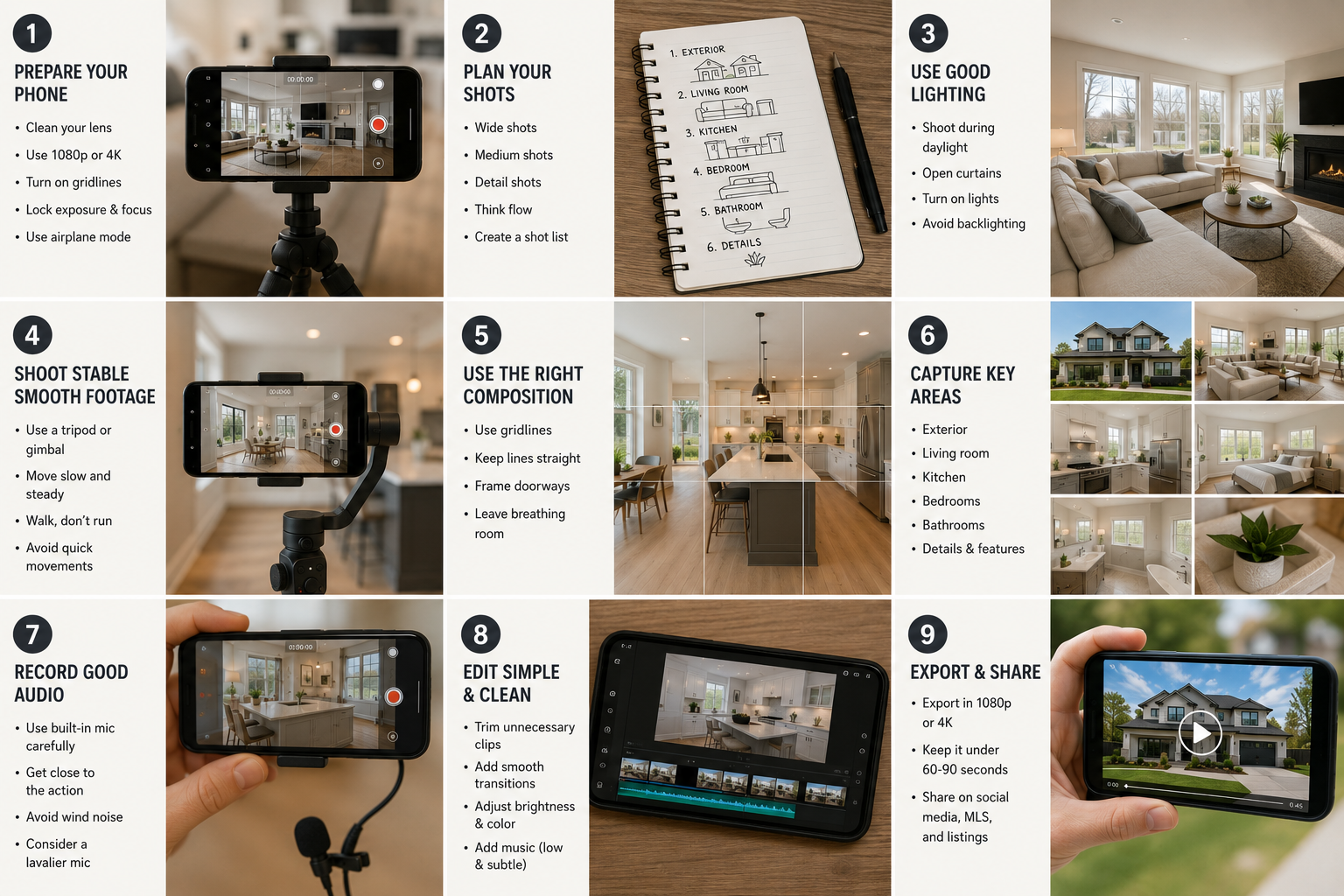
First, switch to the highest video quality available. Ideally, shoot in 4K at 30 frames per second. This creates sharp footage while keeping motion smooth and natural.
Next, clean your camera lens.
Sounds obvious, right?
You'd be surprised how many blurry videos come from fingerprints sitting directly over the lens.
If your phone allows manual exposure adjustments, slightly lower the brightness when filming bright windows. This helps prevent blown-out highlights and preserves detail.
Lock focus whenever possible so the camera doesn't constantly hunt for sharpness while you're moving.
Little tweaks like these instantly make your footage feel more polished.
Use Smooth Camera Movement
Nothing screams amateur faster than shaky footage.
You know the kind.
The camera bounces around like the person filming just drank three energy drinks before walking through the house.
The key is moving slowly and smoothly.
Hold your phone with both hands and keep your elbows close to your body. Walk carefully using a heel-to-toe motion, almost like you're sneaking through the property.
Yeah, it feels a little weird.
But it works.
If you create videos regularly, consider investing in a smartphone gimbal. They're relatively affordable and can transform shaky footage into buttery-smooth walkthroughs.
Even without one, controlled movement goes a long way.
Remember: slow is smooth, and smooth looks professional.
Film Like a Buyer Would Walk Through the Home
One mistake beginners make is randomly jumping from room to room.
Viewers end up confused.
Instead, create a logical flow through the property.
Start outside with the front exterior. Then move through the entryway and continue naturally into the main living areas, kitchen, bedrooms, bathrooms, and outdoor spaces.
Imagine you're giving a tour to a friend who's never seen the home before.
Every shot should help them understand how the property connects together.
This creates a much more immersive experience and helps potential buyers visualize themselves living there.
People aren't just looking at a house.
They're imagining a future lifestyle.
Your video should support that feeling.
Capture Wide Shots First
Real estate is all about space.
That's why wide shots are your best friend.
When entering a room, position yourself in a corner whenever possible. This allows the camera to capture the maximum amount of space and gives viewers a better understanding of the layout.
Most modern smartphones include an ultra-wide camera lens. Use it carefully.
A little extra width helps showcase rooms, but excessive distortion can make spaces look unnatural.
The goal is accuracy.
You want buyers to feel impressed when they arrive in person—not surprised because the room looked twice as large online.
Balanced, realistic wide shots build trust and create a better viewing experience.
Highlight the Home's Best Features
Every property has something worth showing off.
Maybe it's a gorgeous kitchen with quartz countertops. Maybe it's floor-to-ceiling windows overlooking the city. Maybe it's a backyard that looks straight out of a vacation brochure.
Whatever makes the home special deserves extra attention.
Slow down when filming standout features. Create dedicated shots that allow viewers to appreciate the details.
For example:
- Sweep slowly across a luxury kitchen.
- Showcase a fireplace from multiple angles.
- Capture sunlight pouring through large windows.
- Highlight upgraded finishes and fixtures.
Think of these moments as the "wow factor" scenes.
They're often what buyers remember most after the video ends.
Don't Forget Vertical Video
Here's where a lot of agents get stuck in the past.
They still shoot everything horizontally.
While horizontal videos work well on YouTube and websites, vertical content dominates social media.
Platforms like Instagram Reels, TikTok, Facebook Reels, and YouTube Shorts are designed for vertical viewing.
If your goal is maximum reach, vertical video should be part of your strategy.
Some creators even film the entire property twice—once horizontally and once vertically.
It sounds like extra work, but it gives you far more flexibility when distributing content across different platforms.
And let's be honest, social media is where a huge chunk of buyer attention lives these days.
Edit Your Video Without Overcomplicating It
You don't need to become a professional editor overnight.
In fact, simpler is usually better.
Apps like CapCut, Canva, Adobe Express, and other AI-powered editing tools can help you create clean, professional-looking videos in minutes.
Trim unnecessary footage. Add smooth transitions. Include light background music. Insert simple text overlays highlighting key property features.
Avoid flashy effects, wild animations, or transitions that look like they belong in a 2008 music video.
The property should be the focus.
Not your editing skills.
A clean, straightforward video almost always performs better than one overloaded with distractions.
Common Phone Video Mistakes to Avoid
A few mistakes show up again and again in real estate videos.
The first is moving too fast. Rushed footage makes rooms feel smaller and creates a chaotic viewing experience.
The second is filming directly into bright windows without adjusting exposure. This often turns the room into a dark silhouette.
The third is recording vertically when you need horizontal footage—or vice versa.
Another common issue is forgetting to clean the lens. It sounds minor, but it can ruin otherwise great footage.
Finally, many creators use too many clips. A concise 60-90 second video often performs better than a four-minute property marathon.
Keep it simple.
Keep it clean.
Keep viewers engaged.
Final Thoughts
Shooting real estate videos with just your phone isn't a backup plan anymore—it's a legitimate marketing strategy used by agents, investors, and content creators every day.
Modern smartphones are incredibly capable, and when paired with good lighting, smooth movement, thoughtful composition, and basic editing, they can produce videos that look far more expensive than they actually are.
The key is focusing on the property, not the equipment. Buyers care about the experience of the home. They want to see the space, understand the layout, and imagine themselves living there.
Do that well, and nobody will ask whether you used a smartphone or a cinema camera.
They'll be too busy scheduling a showing.
Vídeos imobiliários, simplificados.
Subscrever