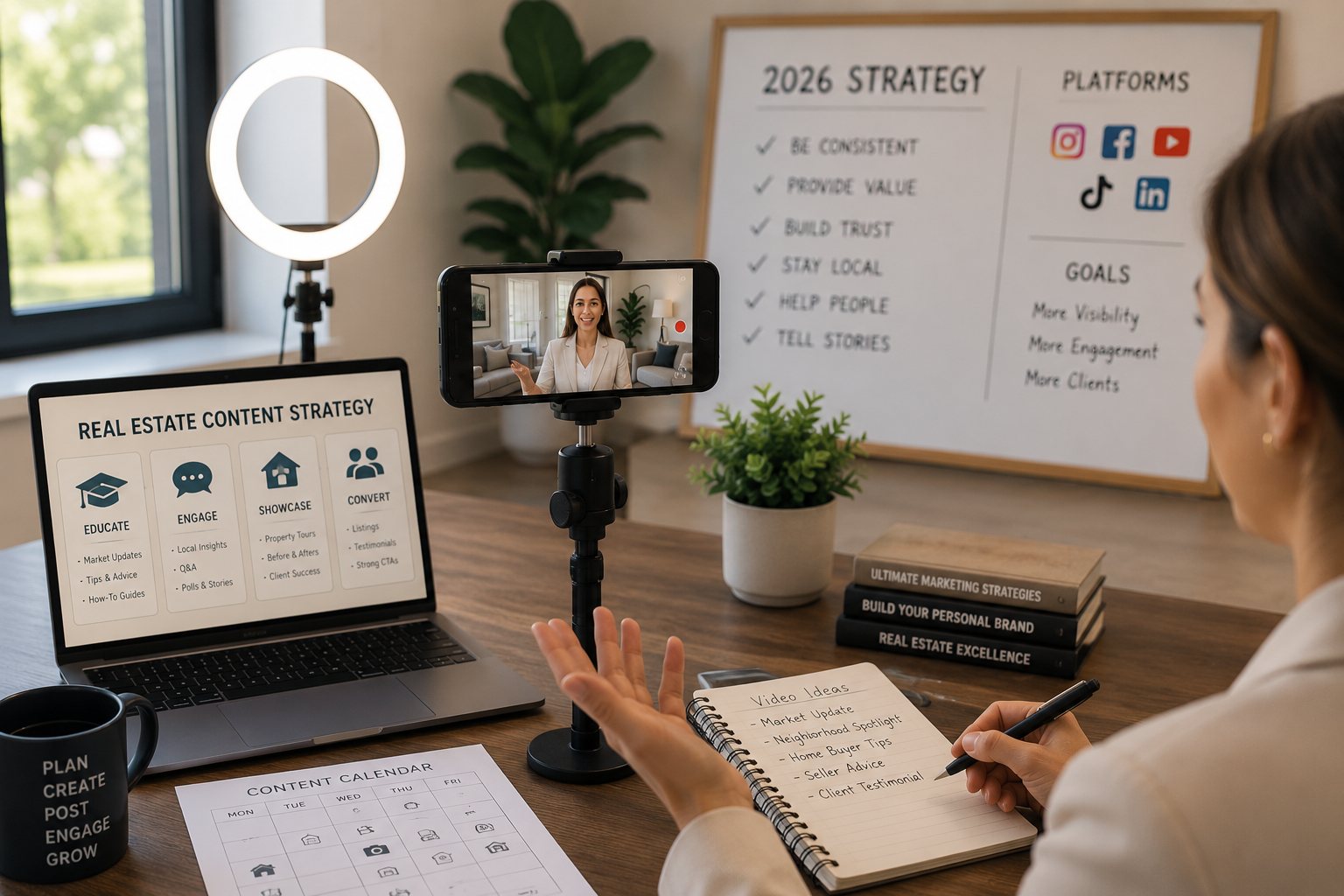
The Real Estate Agent Content Strategy That Works in 2026
Publicado:
July 13, 2026
Real estate content in 2026 is not about posting random house photos and hoping the internet magically drops leads into your lap. That whole “post and pray” thing is cooked. Buyers and sellers are smarter now, feeds are louder, attention spans are shorter, and every agent is fighting to look like the local expert. The agents who win are not always the ones with the fanciest camera, biggest ad budget, or most polished suit. They are the ones with a clear real estate content strategy that makes people trust them before the first call ever happens.
Here is the deal: content is no longer just marketing decoration. It is your digital reputation. Before someone books a consultation, they are checking how you talk, what you know, how you explain things, and whether you seem like a real human or a walking sales script. Your content needs to answer questions, show local knowledge, prove results, and make people feel like, “Okay, this agent actually gets it.” That feeling matters because real estate is emotional, expensive, and full of second-guessing.
The best real estate agent content strategy in 2026 is built around trust, consistency, and usefulness. You need content that attracts attention, but you also need content that warms people up, teaches them something, and gives them a reason to choose you over the other agents in their inbox. That means no more random posting just because you feel guilty for being quiet online. Every piece of content should have a job. Some posts bring visibility. Some build authority. Some prove your value. Some turn quiet lurkers into actual leads. When those pieces work together, content stops feeling like a chore and starts acting like a lead machine.
Why Random Posting Is Dead in 2026
Random posting is dead because people are drowning in content. Every scroll is packed with opinions, listings, memes, home tips, market takes, and agents saying some version of “now is a great time to buy or sell.” The problem is not that people hate real estate content. The problem is that they hate content that feels lazy, generic, or pointless. A blurry open house selfie, a “just sold” graphic with no context, or a market update that sounds like it was copied from a spreadsheet will not make someone stop and think, “Wow, I trust this person with my biggest financial move.”
In 2026, your audience needs a reason to care fast. A buyer wants to know how your content helps them make a smarter move. A seller wants to know whether you understand pricing, prep, negotiation, and marketing. A relocation client wants to know whether you can explain the local area without sounding like a brochure. A first-time buyer wants someone to make the process less scary. If your content does not help one of those people, it is probably just noise.
A real strategy gives your content direction. Instead of asking, “What should I post today?” you start asking, “What does my audience need to understand before they trust me?” That question changes everything. Your content becomes less about filling space and more about moving people through a journey. They discover you, learn from you, trust you, and eventually reach out. That is the difference between content that looks busy and content that actually works.
Attention Is Expensive, So Your Content Needs a Job
Attention is the currency of modern real estate marketing, and it is not cheap. Even if you are not paying money for every view, you are still paying with time, energy, creativity, and consistency. So when you post something, it needs to earn its spot. A post should not exist just because you heard agents should “stay active online.” That is weak sauce. Every piece of content should do at least one clear thing: educate, entertain, build trust, show proof, start a conversation, or move someone toward a next step.
For example, a quick video explaining why overpriced homes sit longer has a job. It educates sellers and positions you as someone who understands market psychology. A neighborhood guide has a job. It attracts buyers and proves local expertise. A client story has a job. It builds confidence by showing how you solve real problems. A personal behind-the-scenes post has a job too. It makes you more relatable and reminds people there is an actual human behind the business.
The mistake many agents make is confusing activity with strategy. Posting five times a week means nothing if every post feels random. You could post less often and get better results if each piece of content has a clear purpose. That is not permission to disappear for three weeks and blame the algorithm. It means consistency plus intention beats chaos every time. Content should work like a team, not like a pile of disconnected flyers thrown into the wind.
Buyers and Sellers Want Proof Before They Talk
People do not want to call an agent just to find out whether that agent is any good. They want clues first. They want proof. They want to see how you think, how you explain, how you market, and whether you seem trustworthy. This is especially true for sellers because choosing the wrong listing agent can cost real money. A seller is not just looking for someone who can put a sign in the yard. They are looking for someone who can price correctly, create demand, negotiate strongly, and keep the process from turning into a circus.
Content gives them that proof before the appointment. When a homeowner sees your videos about pricing strategy, home prep, buyer behavior, and local market shifts, they start building confidence in your expertise. When a buyer sees your content explaining inspections, offers, neighborhoods, and financing basics, they feel less overwhelmed. By the time they contact you, they are not ice-cold. They already know your voice, your style, and your approach.
That is why content in 2026 needs to be more than pretty. Pretty gets attention for five seconds. Proof builds trust for months. The best agents use content like a public portfolio of their brain. They show their process. They explain decisions. They share lessons from real deals without exposing private details. They make their expertise visible. When people can see your value before they need you, you become the obvious choice when the timing finally clicks.
Build Your Strategy Around Trust, Not Just Views
Views are nice, but views are not the same thing as trust. A funny video can get attention and still bring zero serious leads. A beautiful listing clip can get likes from people who are not buying, selling, or even living in your market. That does not mean views are useless, but they are only the top layer. The real question is whether your content makes the right people trust you more. If it does, you are building a business asset. If it does not, you are just feeding the content monster.
A trust-based content strategy is different from a vanity-based strategy. Vanity content asks, “How do I get more likes?” Trust content asks, “How do I make buyers and sellers feel more confident choosing me?” That second question creates better topics. It pushes you to answer real concerns, show your local knowledge, explain your process, and share proof. It also keeps you from chasing every trend like a squirrel on energy drinks. Trends can help, but they should not replace substance.
Trust grows when people feel that you are honest, consistent, and useful. You do not need to sound perfect. Actually, sounding too perfect can make you seem fake. People want a real person who knows the market and can explain it clearly. Speak like you would at a kitchen table. Use normal language. Share opinions. Admit trade-offs. If an area is great but expensive, say that. If a seller mistake is common, explain it without being condescending. That is how content starts feeling like advice instead of advertising.
Content Should Make People Feel Safe Choosing You
Buying or selling property can make people feel exposed. They are dealing with money, timing, family pressure, paperwork, competition, inspections, negotiations, and a thousand little “what if” questions. Good content reduces that anxiety. It makes people feel like there is a path, a plan, and someone who can guide them through it without making them feel dumb. That is a massive part of why content converts.
A buyer who watches your video about what happens after an offer is accepted feels more prepared. A seller who reads your post about whether to renovate before listing feels less likely to waste money. A relocating client who watches your area guide feels less lost. These are not just content touches. They are trust deposits. Every helpful piece says, “I know this process, and I can help you navigate it.” That feeling is what turns quiet followers into leads.
The best content also sets expectations. It explains what clients should know before they are in the middle of a stressful decision. This helps you attract better clients because they arrive more informed. They understand why pricing matters, why preparation matters, why pre-approval matters, and why strategy matters. Instead of spending every call correcting myths, you start with a more educated audience. That makes your business smoother and your clients more confident.
Your Personality Is Part of the Product
A lot of agents are scared to show personality because they think professional means polished, serious, and slightly boring. Nope. Professional does not mean robotic. In 2026, personality is part of the product because clients are not just hiring your license. They are hiring your communication style, judgment, energy, and ability to guide them through a stressful process. Your content should give people a taste of what working with you actually feels like.
That does not mean you need to act loud, goofy, or fake. You do not need to dance, shout, or pretend to be a lifestyle influencer if that is not you. But you do need to sound like yourself. If you are calm and analytical, lean into that. If you are direct and no-nonsense, use it. If you are warm and funny, let that come through. The goal is not to appeal to everyone. The goal is to attract people who connect with your style.
Personality also makes your content more memorable. Many agents can explain closing costs. Fewer can explain it in a way that feels clear, relaxed, and human. Many agents can say a neighborhood is desirable. Fewer can say, “This area is perfect if you want quiet streets but still need decent coffee within five minutes.” That tiny bit of personality makes the content feel alive. People remember humans, not templates.
The Four Content Pillars Every Agent Needs
A strong real estate content strategy needs pillars. Without pillars, content gets messy fast. One day you post a listing, the next day a random quote, then a market chart, then a photo of your lunch, then silence. That is not a strategy. Pillars give your content structure so your audience knows what to expect and your brain does not melt every time you need to post. For real estate agents in 2026, the four essential content pillars are local authority, education, proof, and personal brand.
These pillars work together because they cover different parts of the client journey. Local authority helps people believe you know the market. Educational content helps them understand the process. Proof-based content shows that your advice leads to real outcomes. Personal brand content makes you relatable and memorable. If you only post one type, your strategy feels incomplete. Too much education can feel dry. Too much personal content can feel unfocused. Too much proof can feel like bragging. The balance is what makes it work.
Think of these pillars like legs on a table. If one is missing, the whole thing gets wobbly. You need enough local content to own your area, enough education to build trust, enough proof to show you can deliver, and enough personality to make people care. This gives your content depth and variety without becoming random. It also helps you plan faster because every post fits into a category.
Local Authority Content
Local authority content is how you become known as the agent who actually understands the area. This is not just saying, “I’m a local expert.” Everyone says that. Local authority means proving it through useful, specific, boots-on-the-ground content. Talk about neighborhoods, streets, school zones, commute patterns, market pockets, local development, lifestyle differences, housing styles, price ranges, and what buyers should know before choosing one area over another.
The best local content is specific enough to be useful. “Best neighborhoods in town” is okay, but “Best neighborhoods for buyers who want walkability without downtown noise” is much stronger. “Market update” is fine, but “Why homes under this price range are moving faster in this area” is better. People do not want vague local fluff. They want context that helps them make decisions. The more specific you are, the more credible you sound.
Local authority content also attracts both buyers and sellers. Buyers use it to figure out where they want to live. Sellers watch it and realize you know how to market their area. That is the double win. A homeowner is more likely to trust an agent who can explain why their neighborhood matters, not just list bedroom counts and square footage. Local content turns you into a guide, and guides get hired.
Educational Content
Educational content is the trust builder. It answers the questions buyers and sellers are already asking, plus the questions they do not even know they should ask yet. For buyers, this could include pre-approval, inspections, offer strategy, closing costs, contingencies, appraisal issues, and how to compare homes. For sellers, it could include pricing, staging, repairs, timing, negotiation, showings, and what actually happens after accepting an offer.
The secret is to keep it simple without making it shallow. Real estate can be confusing, and your job is to translate. Do not hide behind industry jargon. Explain things like you would to a smart friend who has never done this before. For example, instead of saying, “Market absorption is changing,” say, “Homes are still selling, but buyers are being pickier, so overpriced listings are getting punished.” That lands better because it sounds like real talk.
Educational content also helps pre-sell your process. When people understand why you recommend certain steps, they are more likely to trust you later. A seller who has watched your videos about pricing is less shocked when you explain realistic value. A buyer who has learned from your content is more likely to get pre-approved before touring. Education saves time, reduces friction, and makes leads warmer.
Proof-Based Content
Proof-based content shows that you do not just talk a good game. You actually deliver. This includes case studies, client stories, before-and-after prep examples, sold breakdowns, negotiation wins, marketing results, and lessons from real transactions. The key is to frame proof content around what your audience can learn, not just around how amazing you are. Nobody wants a nonstop flex parade. But people do want evidence that you know what you are doing.
A great proof post might explain how a home sold faster because of smart pricing and preparation. It might show how staging changed buyer perception. It might break down why one listing attracted stronger activity than similar homes nearby. It might explain how you helped a buyer win without overpaying. These stories make your expertise tangible. They show your thought process in action.
Proof content is especially powerful for seller leads. Sellers want to know whether you can market, negotiate, and guide them. When they see real examples, your value becomes easier to understand. It also helps separate you from agents who only make big claims. Claims are cheap. Proof is sticky. If your content regularly shows how you solve problems, people start believing you can solve theirs too.
Personal Brand Content
Personal brand content makes people feel like they know you. This does not mean dumping your private life online or turning every post into a diary. It means showing enough personality, values, behind-the-scenes moments, and real human context that people can connect with you. Real estate is a relationship business. If your content is only tips and listings, people may respect you but not feel connected. Personal brand content closes that gap.
This could be a quick story about a lesson learned during a tough deal, a behind-the-scenes look at preparing for a listing, your honest take on a market myth, a day-in-the-life clip, or a personal reason you love a certain neighborhood. The goal is to show the human behind the expertise. People want to know what you are like under pressure. They want to sense whether you are patient, sharp, calm, funny, direct, or thoughtful.
The trick is to keep personal content connected to your brand. A random photo with no point may not help much. But a personal story that reveals how you think, serve, or communicate can be powerful. Let people see your standards. Let them see your work ethic. Let them see your local life. In a sea of agents posting the same generic content, personality is how you become memorable.
Video Is the Core of Real Estate Content in 2026
Video is the center of real estate content in 2026 because it builds trust faster than text or photos alone. People can hear your tone, see your face, watch how you explain things, and feel your confidence. That matters because buyers and sellers are not just choosing information. They are choosing a person. A good video can make a stranger feel familiar before you ever speak directly. That is a huge advantage.
Video also helps explain real estate better. Layout, neighborhood vibe, market nuance, home prep, negotiation strategy, and buyer behavior are all easier to understand when someone walks you through them. A written post can be helpful, but video feels more personal. It creates a mini conversation. And in a business where trust drives decisions, that personal feeling matters.
But video in 2026 does not mean every agent needs expensive production every day. You need a mix. Some videos should be simple and fast: quick tips, market thoughts, open house clips, behind-the-scenes moments. Others should be more polished: property tours, neighborhood guides, seller education, buyer guides, and case studies. The goal is not perfection. The goal is consistent, useful visibility. Show up with value, sound like yourself, and make the viewer’s next decision easier.
Short-Form Video Creates Fast Visibility
Short-form video is the attention grabber. It is the quick hit that gets you in front of people who may not know you yet. These clips work best when they focus on one idea and open with a strong hook. “Do not list your home before checking this.” “This is why buyers are skipping some listings.” “Here is the neighborhood mistake relocation buyers make.” Those openings work because they create curiosity immediately.
The mistake agents make is trying to cram too much into one short video. A 30-second clip should not explain the entire buying process. Pick one point and make it useful. Talk about a pricing mistake, a showing tip, a neighborhood trade-off, a home inspection red flag, or a simple market shift. Keep it clear. Keep it moving. Give people one takeaway they can remember.
Short-form video is also great for staying top of mind. Someone may not need you today, but if they see your helpful clips over and over, you become familiar. That familiarity matters when their timeline changes. They may not remember every tip, but they will remember that you consistently showed up with useful real estate advice. That is how visibility turns into trust over time.
Long-Form Video Builds Serious Intent
Long-form video is where deeper trust happens. A person who watches a full neighborhood guide, seller strategy video, buyer roadmap, or detailed market breakdown is showing stronger intent than someone who casually liked a quick clip. Long-form content gives you room to explain nuance, share examples, and prove that you actually understand the topic. It is perfect for serious buyers and sellers who are researching before they reach out.
This type of content is especially strong for local authority. A detailed guide about living in a specific area can attract buyers who are actively considering that location. A seller-focused video about pricing strategy can warm up homeowners who are quietly planning a sale. A longer video about how to sell and buy at the same time can speak directly to move-up clients who feel overwhelmed. These are not random viewers. They are people with real questions.
Long-form video also becomes evergreen content. A strong guide can keep working for months or even years if the information stays relevant. You can cut it into shorter clips, turn it into a blog, use it in email follow-up, and send it to leads who ask related questions. That is how one piece of content becomes many. Long-form video builds depth, and depth is what separates serious agents from random content posters.
How to Turn Content Into Real Leads
Content does not automatically generate leads just because it exists. It needs a path. A person watches, reads, learns, trusts, and then needs a clear next step. Without that next step, even great content can leak opportunities. A viewer may think, “This agent seems helpful,” but if you do not make it easy to start a conversation, they may keep scrolling and forget. Attention is slippery. You have to guide it.
The best lead-generating content connects directly to the viewer’s situation. A buyer education post should invite people to ask for a buyer plan or home search. A local guide should invite them to request neighborhood recommendations. A seller pricing video should invite them to get a realistic home value review. A case study should invite sellers to talk about a strategy for their own property. The offer should feel natural, not pushy.
You also need content for different levels of readiness. Some people are cold and just learning. Some are warm and quietly planning. Some are ready to act. If all your content says “call me now,” you will miss the people who need nurturing. If all your content educates but never asks for action, you will miss ready leads. A strong strategy includes both. Teach generously, then make the next step obvious when the viewer is ready.
Every Post Needs a Next Step
A next step does not always have to be a hard call-to-action. Sometimes it can be as simple as “save this,” “send me your question,” “ask for the checklist,” or “message me your neighborhood.” The point is to train your audience to interact with you. Real estate decisions often start with small conversations. A person who replies to a story, comments on a market post, or asks for a guide may become a client later. Do not underestimate tiny doors.
Your call-to-action should match the content. If you post about seller prep, offer a prep checklist or consultation. If you post about neighborhoods, offer a custom area match. If you post about buying mistakes, invite people to ask for a first-time buyer roadmap. If you post a market update, ask whether they want to know what it means for their home or budget. The more relevant the next step, the less salesy it feels.
Do not make people hunt for contact options either. Your profiles, website, email signature, and content captions should make it obvious how to reach you. Keep forms simple. Keep offers clear. Keep the language human. “Send me your address and I’ll give you a realistic value range” is better than “complete this inquiry form to initiate a consultation process.” One sounds like help. The other sounds like paperwork with a tie on.
Follow-Up Content Is Where Deals Warm Up
The money is often in the follow-up. A person may watch your content and reach out, but that does not mean they are ready to sign immediately. They might be three months out, six months out, or just starting to explore. This is where many agents drop the ball. They either push too hard or disappear completely. Both are bad. Follow-up content keeps the relationship warm without making the person feel hunted.
A smart follow-up system uses helpful content based on the lead’s interest. If someone asks about selling, send them seller prep tips, pricing videos, and local market updates. If someone asks about buying, send neighborhood guides, financing basics, and showing strategy content. If someone is relocating, send area comparisons and lifestyle videos. This makes your follow-up feel personalized because it actually helps.
Personal video messages can also work extremely well. A quick custom clip saying, “Hey, I saw you were looking at this area, here are two things to know,” feels way warmer than a generic email. You do not need to overproduce it. The value is the personal attention. In 2026, automation is everywhere, so real human follow-up stands out. Content gets people interested. Follow-up turns interest into relationships.
The Weekly Content System That Actually Works
A content strategy only works if you can actually stick with it. The best plan in the world is useless if it burns you out after two weeks. Real estate agents are busy. You have clients, showings, contracts, negotiations, inspections, calls, and random chaos popping up constantly. So your content system needs to be simple, repeatable, and realistic. If it depends on you feeling inspired every morning, it will fail.
A strong weekly system might include one local authority piece, one educational piece, one proof-based piece, and one personal brand piece. That gives you balance without overcomplication. For example, one neighborhood video, one buyer or seller tip, one case study or result breakdown, and one behind-the-scenes post. From those core pieces, you can create shorter clips, email content, and quick text posts. You do not need fresh ideas every hour. You need a rhythm.
The goal is to create content in batches. Record several videos at once. Write captions in one sitting. Turn one longer topic into multiple smaller posts. Save client questions as future content ideas. Keep a running list of market observations. Your daily work already gives you content. You just need a system to capture it. When content becomes part of your workflow instead of a separate monster, it gets much easier.
Batch, Repurpose, and Stop Overthinking
Batching is your best friend. Instead of recording one video every day while stressed and half-ready, set aside a block of time and record several at once. Bring a list of topics. Keep each video focused. Change locations or angles if you want variety, but do not make it complicated. The goal is to create usable content, not win a film festival. Done with strategy beats perfect but never posted.
Repurposing is how you get more mileage from every idea. A long neighborhood guide can become short clips, a blog post, an email, a buyer resource, and several social captions. A seller pricing video can become a checklist, a carousel-style post, a follow-up email, and a talking point in listing appointments. A client success story can become a proof post, a video breakdown, and a seller presentation example. One idea should not die after one post.
Stop overthinking every piece of content like it needs to be your masterpiece. Your audience does not need perfection. They need consistency and usefulness. Some posts will perform better than others. That is normal. Pay attention to what gets saves, replies, shares, and real conversations. Then make more of that. Content strategy is not a one-time plan. It is a feedback loop. Post, learn, improve, repeat. That is how agents build momentum without losing their minds.
Conclusion
The real estate agent content strategy that works in 2026 is not random, robotic, or built only for views. It is built around trust. The agents who win are the ones who create content that answers real questions, proves local expertise, shows results, and lets people feel their personality before the first conversation. Buyers and sellers want proof before they reach out. Your content should give them that proof in a way that feels human, useful, and easy to understand.
The strongest strategy uses four core pillars: local authority, education, proof, and personal brand. Local content shows you know the market. Educational content makes people smarter. Proof content shows you can deliver. Personal brand content makes you memorable. Add video as the core format, use short-form content for visibility, long-form content for deeper trust, and follow-up content to warm leads into real conversations.
You do not need to post like a maniac or become someone you are not. You need a repeatable system. Batch your content, repurpose your best ideas, speak like a real person, and make every post serve a purpose. In 2026, content is not just about being seen. It is about being trusted before people need you. And when your content does that well, leads stop feeling like random luck and start becoming the natural result of a smart strategy.
Vídeos imobiliários, simplificados.
Subscrever