Why Every Realtor Should Create Local Area Video Guides
Published:
July 11, 2026
If you are a Realtor and you are still only posting listing photos, “just sold” graphics, and the occasional selfie at an open house, you are leaving a ridiculous amount of trust on the table. The market has changed, and buyers are not just shopping for homes anymore. They are shopping for neighborhoods, lifestyle, commute time, coffee spots, school zones, weekend energy, walkability, safety, and that hard-to-explain feeling of, “Yeah, I could actually live here.” That is exactly why local area video guides are becoming one of the smartest tools in modern real estate video marketing.
A property listing can show the kitchen, the bedrooms, the backyard, and the cute little breakfast nook everyone pretends they will use daily. But a local area video guide shows the life around the home. It answers the questions buyers are already Googling late at night: “Is this neighborhood good for families?” “What is it like living in this suburb?” “Is downtown too noisy?” “Can I walk to restaurants?” “Where do locals actually hang out?” When you create videos that answer those questions, you stop looking like a salesperson and start looking like a legit local advisor.
And sellers? Oh, they are watching too. Homeowners want to hire an agent who can market more than four walls and a roof. They want someone who understands why their neighborhood is valuable and can explain that value to buyers in a way that feels real. When sellers see you making helpful, polished, personality-packed area guides, they start thinking, “This agent actually knows how to sell the lifestyle of my home.” That is a big deal. In a crowded market where every agent claims to be “local,” video is how you prove it without sounding like every other business card in town.
Why Local Area Video Guides Are a Big Deal
Local area video guides are a big deal because they answer the part of real estate that photos, floor plans, and MLS descriptions cannot fully explain. A home might look perfect online, but buyers still want to know what it feels like to live there. Is the street quiet or busy? Are there parks nearby? Is the neighborhood full of young families, professionals, retirees, students, or a little bit of everything? Are the restaurants actually good, or is it just one sad pizza place and a gas station pretending to be a shopping district? These are the details that shape real buying decisions.
The old-school way of selling real estate was mostly property-first. Agents would promote the house, mention the square footage, throw in “close to amenities,” and call it a day. But buyers today are smarter, more visual, and way more research-heavy. They do not want vague claims. They want context. A neighborhood video guide gives them that context in a way that feels easy to consume. Instead of reading a dry blog post about local features, they can watch you walk through the area, point out hidden gems, explain market trends, and give them a real sense of the place.
For Realtors, this is a massive branding opportunity. Anyone can say, “I know the area.” But when you create consistent video guides about local communities, parks, schools, restaurants, subdivisions, condo buildings, and lifestyle pockets, you are showing your expertise in public. That is way more powerful. It is like the difference between saying you are a great cook and inviting people into the kitchen while you make the meal. Video lets people see your knowledge in action. And when buyers and sellers see that often enough, you become the person they associate with that local market.
Buyers Want the Vibe, Not Just the Listing
Buyers care about the listing, of course, but the listing is only one piece of the puzzle. The real question in their head is, “Can I picture my life here?” That is why local video guides work so well. They help buyers feel the rhythm of an area before they ever schedule a showing. A three-bedroom home can look great in photos, but if the buyer does not understand the neighborhood, they may hesitate. On the flip side, a home that looks “pretty good” can become way more attractive when the buyer sees the nearby park, the cool brunch spot, the short commute, and the quiet streets around it.
This is where Realtors can really flex their local knowledge. You can talk about what it is like on a Saturday morning, where people grab coffee, which streets feel more peaceful, what the commute is like during rush hour, and which amenities actually matter. That kind of info feels valuable because it sounds like something only a local would know. It is not the generic “great location” fluff that buyers have read a thousand times. It is real insight. And real insight makes buyers trust you faster.
A good area guide also helps buyers emotionally connect with a place. Buying a home is logical, but it is also deeply emotional. People imagine walking their dog, raising kids, hosting friends, building routines, and creating a new chapter. Your video can help them imagine that. When you show the neighborhood in motion, you are not just marketing geography. You are marketing possibility. That is why a simple, honest, well-made video guide can do more for buyer interest than another over-edited listing clip with dramatic music and slow-motion faucet shots. The house matters, but the vibe often closes the loop.
Sellers Want Proof You Know Their Neighborhood
Sellers are not just asking, “Can this agent sell my house?” They are asking, “Can this agent explain why my home is worth what I think it is worth?” That is a very different question. A seller may love their home because of the nearby trails, the quiet cul-de-sac, the schools, the neighbors, the walkability, or the local restaurants. They want an agent who can understand those value points and communicate them to buyers. A local area video guide proves that you can do exactly that.
When a homeowner sees you creating smart content about their neighborhood, something clicks. They realize you are not just plugging homes into the MLS and hoping for the best. You are actively marketing the area. You know how to tell the story behind the location. That matters because location is one of the biggest drivers of buyer emotion and property value. A seller does not want their home described as “close to shops and dining.” They want it positioned as part of a lifestyle that buyers can feel excited about.
This is also a huge listing appointment advantage. Imagine sitting across from a seller and saying, “I do not just market the home. I market the neighborhood around it, and here are the video guides I have already created for this area.” That is a mic-drop moment. It shows preparation, authority, and a bigger marketing vision. Most agents will talk about photos, flyers, portals, and maybe social media. You can show an actual content ecosystem that brings the area to life. That makes you look like a marketer, not just a license holder. And in the seller’s mind, that can be the difference between “maybe” and “where do we sign?”
Video Guides Build Local Authority Fast
Local authority is one of those phrases agents love to throw around, but the real meaning is simple: when people think about real estate in a specific area, they think of you. That does not happen by accident. It happens because you show up consistently with useful, relevant, local content. Local area video guides are one of the fastest ways to build that authority because they combine expertise, personality, visuals, and search-friendly content in one package. You are not just telling people you know the market. You are giving them proof they can watch.
The beautiful thing about local video is that it compounds. One guide about a neighborhood might get a few views at first. Then someone searching YouTube finds it. Then a buyer shares it with their spouse. Then a seller sees it on Facebook. Then you clip it into shorter videos for Instagram and TikTok. Then you embed it in a blog post. Over time, one piece of content can keep working for you like a little digital employee who never calls in sick. That is the power of evergreen local content.
Authority also comes from repetition. If you make one video and disappear for three months, people forget. But if you regularly cover neighborhoods, market updates, local businesses, new developments, parks, schools, and lifestyle topics, your name starts to stick. People begin to see you as the person with the answers. You become familiar before they ever need you. That is exactly where you want to be because real estate decisions often have a long runway. Someone may watch your content for months before they finally reach out. Video keeps you in their world without you needing to chase them like a needy sales gremlin.
They Turn You Into the Face of the Area
Being the “face of the area” sounds a little cheesy, but it is insanely valuable. When people repeatedly see your face connected to useful local information, they start to associate you with that community. You become part of the mental map. That is powerful because real estate is still a relationship business, even when the first contact happens online. People want to hire someone they feel they know. Video builds that feeling way faster than text, photos, or static ads.
Think about how people choose local experts. They often go with the person who feels familiar, visible, and confident. A homeowner may not remember a postcard they threw away six weeks ago, but they might remember the agent who made a fun video about the best streets for walkability or the hidden park most buyers miss. Familiarity creates comfort. Comfort creates trust. Trust creates appointments. It is not magic. It is just human behavior.
Local area video guides also help you stand out from agents who only appear when they have something to sell. If your entire online presence is “new listing, sold, new listing, sold,” people learn to ignore you because every post feels like an ad. But when you show up as a community guide, your content feels more useful and less pushy. You are not just saying, “Hire me.” You are saying, “Let me help you understand this place.” That shift makes your brand feel more generous, more informed, and honestly, more likable. And likability matters more than most agents want to admit.
They Make Your Brand Feel Human
A lot of real estate marketing feels painfully generic. Same headshots, same slogans, same “dream home” captions, same awkward stock music. Local video guides give you a chance to break out of that boring box and show some actual personality. You can laugh, tell stories, share honest opinions, point out local quirks, and speak like a real person instead of a brochure wearing a blazer. That human touch is what makes people remember you.
The best video guides do not feel overly scripted. They feel like a knowledgeable local friend showing someone around town. That does not mean you should ramble for twenty minutes with no plan. It means you should prepare your points, then deliver them naturally. Talk about what you genuinely like. Mention who the area is best for. Be honest about trade-offs. If parking is annoying downtown, say that. If a neighborhood is beautiful but pricey, say that too. People trust balanced advice more than nonstop hype.
Human branding also helps attract the right clients. Your tone, style, and opinions will naturally connect with some people and repel others, and that is not a bad thing. You do not need every buyer or seller in the city to love you. You need the right ones to feel like you are their kind of agent. Local video gives them a taste of your communication style before they ever book a call. That means by the time they contact you, they are usually warmer, more aligned, and less likely to treat you like just another random agent.
Local Video Guides Improve Real Estate SEO
If you care about long-term lead generation, local video guides are not just good for branding. They are also a serious real estate SEO play. Buyers and sellers search for local information all the time. They type things like “best neighborhoods in Austin for families,” “living in Scottsdale,” “moving to Tampa,” “pros and cons of downtown condos,” or “best suburbs near Denver.” If you create helpful video content around those searches, you give yourself a better chance to show up where people are already looking.
Video is especially powerful because it can rank in multiple places. Your YouTube video can show up in YouTube search. It can appear in Google search results. It can be embedded in a blog post on your website. Clips from it can live on Instagram, TikTok, Facebook, LinkedIn, and email campaigns. That means one local guide can support your visibility across several channels. This is not about chasing one viral hit. It is about building a searchable library of content that keeps attracting attention over time.
The SEO advantage also gets stronger when your videos are specific. A broad video called “Living in California” is probably too competitive and too vague. But a video about “Living in [Specific Neighborhood]” or “Pros and Cons of [Specific Suburb]” has a much clearer audience. Local searches often have stronger intent because the viewer is already focused on a real place. That means the traffic may be smaller, but the lead quality can be much better. In real estate, that is exactly what you want. Ten serious local viewers are more valuable than ten thousand random people who just like pretty houses.
Google and YouTube Love Useful Local Content
Google and YouTube are built to serve people useful answers, and local area video guides can do that beautifully when they are done right. A strong video can answer common questions about lifestyle, commute, price ranges, housing styles, amenities, schools, transportation, walkability, and market trends. That is the kind of content people actually search for. When your video title, description, transcript, and supporting blog content all focus on a specific local topic, you make it easier for search engines to understand what your content is about.
The mistake many agents make is treating YouTube like a dumping ground for random listing videos. Listing videos are useful, but they often have a short shelf life. Once the home sells, the content becomes less relevant. Local area guides are different. A neighborhood guide can stay useful for months or even years if the core information is solid. You can update it later, create a newer version, or add follow-up videos as the area changes. This gives your content more long-term value.
To make these videos work harder for SEO, use natural keywords people actually search. Put the neighborhood or city name in the title. Write a real description, not two lazy sentences. Add chapters if the video is longer. Mention nearby landmarks, community names, and lifestyle features. Embed the video in a matching blog post on your site. The goal is not to stuff keywords like a spam sandwich. The goal is to make your content clearly useful and locally relevant. When you do that consistently, you give both people and search engines a better reason to pay attention.
One Guide Can Feed Multiple Platforms
One of the best things about local area video guides is how easy they are to repurpose. A single 8-minute neighborhood guide can become a YouTube video, a blog post, three Instagram Reels, two TikToks, a Facebook post, a LinkedIn update, an email newsletter feature, a Google Business Profile post, and a short clip for a listing presentation. That is not extra work. That is leverage. And if you are a busy Realtor, leverage is your best friend.
Here is the smart way to think about it: your long-form video is the main meal, and your short clips are the snacks. The full guide gives serious buyers and sellers depth. The clips create quick attention and send people toward the bigger resource. For example, one short clip might cover “best coffee shops in the area,” another might cover “who this neighborhood is perfect for,” and another might cover “one thing buyers should know before moving here.” Each clip has its own angle, but they all support the same local authority.
This repurposing strategy also makes content creation less overwhelming. Many agents struggle because they think they need brand-new ideas every day. You do not. You need strong core content that can be sliced, edited, and reused in smart ways. A well-planned local guide gives you a content bank. You can keep pulling value from it long after filming day. That means you stay visible without living your entire life on camera. Work smarter, not harder — yes, it is a cliché, but in this case, it is dead-on.
Content Type
Best Platform
Main Purpose
Full neighborhood guide
YouTube, website
Build authority and rank in search
Short local clips
Instagram, TikTok, Shorts
Grab attention and stay visible
Blog version
Website, Google
Support local SEO
Email feature
Newsletter
Nurture buyers and sellers
Listing presentation clip
Seller meetings
Prove marketing expertise
Better Buyer Leads Start With Better Local Content
Not all buyer leads are created equal. Some are serious, informed, and ready to move. Others are just browsing because they got bored at lunch. Local video guides help attract better buyer leads because they educate people before they contact you. By the time someone reaches out after watching your area guide, they usually have more context. They know the neighborhood better. They understand the lifestyle. They may already feel connected to the area. That makes the conversation more productive from the start.
This is especially helpful because buyers often begin their search with location confusion. They may know the general city but not the neighborhoods. They may be moving from out of state and have no clue which suburb fits their life. They may think they want one area because it looks cool online, then realize the commute is brutal or the housing style does not match their needs. Your video guides help them sort through those questions. You become the guide before you become the agent.
Better local content also helps reduce wasted time. If your video honestly explains who an area is good for and who might not love it, some buyers will self-select out. That is a good thing. You do not need more random leads. You need better-fit leads. A buyer who watches your guide and says, “This is exactly what we are looking for,” is much more valuable than someone who knows nothing and needs to start from zero. Local area guides help educate, qualify, and warm up leads all at once.
Relocation Buyers Need Context Before They Visit
Relocation buyers are one of the biggest reasons every Realtor should create local area video guides. These buyers are making decisions from a distance, and distance creates anxiety. They cannot easily drive around after work, check out the grocery store, visit schools, test the commute, or walk through the neighborhood at different times of day. They rely heavily on online content. If you are the agent giving them clear, honest, visual context, you instantly become more valuable.
Relocation buyers do not just need property tours. They need orientation. They need to understand how the city is laid out, where people commute from, which neighborhoods are quieter, which areas feel more urban, which suburbs are better for space, and what daily life might look like. A video guide can explain all of this in a way that feels personal and digestible. It is like giving them a virtual scouting trip without making them buy a plane ticket.
These buyers are also more likely to build trust through video because they cannot meet you in person right away. Seeing your face and hearing your explanations helps them feel less alone in the process. They get a sense of how you communicate, how well you know the area, and whether you are honest about pros and cons. That last part matters a lot. Relocation buyers are scared of making a mistake. If your videos only hype every neighborhood as “amazing,” you lose credibility. But if you say, “This area is great for walkability, but parking can be a pain,” they trust you more because you sound real.
Neighborhood Videos Filter Out Bad-Fit Leads
A lot of Realtors think more leads automatically means more business, but that is not always true. More bad-fit leads can just mean more wasted calls, more confusing showings, and more people ghosting after asking seventeen questions. Local area video guides help filter leads before they contact you. They give people enough information to decide whether an area truly fits their needs. That makes your pipeline cleaner.
For example, a buyer might think they want a trendy downtown neighborhood because it looks fun on Instagram. But after watching your guide, they realize the parking, noise, and smaller square footage are not ideal for their family. Great. You just saved yourself and that buyer a bunch of wasted time. Another buyer might discover that a quieter suburb with parks and larger lots is actually a better fit. Now the conversation starts in a more focused place.
Filtering does not mean discouraging people. It means being honest enough to attract the right people. Your goal is not to make every neighborhood sound perfect. Your goal is to explain each area clearly so buyers can make smarter decisions. That kind of honesty creates trust, and trust creates loyalty. When buyers feel like you are not just trying to sell them anything with a front door, they are more likely to stick with you. In real estate, being a trusted filter is often more valuable than being a walking sales pitch.
Sellers Notice Agents Who Market the Community
Sellers pay attention to how agents market homes, and smart sellers are paying even closer attention to how agents market the surrounding area. A home does not exist in a vacuum. The neighborhood, nearby amenities, schools, lifestyle, commute, and local energy all influence buyer interest. When you create local area video guides, sellers see that you understand this bigger picture. You are not just marketing properties. You are marketing place, and that is exactly what many sellers want.
This is especially important in competitive listing situations. A seller may interview multiple agents who all promise professional photos, MLS exposure, open houses, and social media promotion. Those things are expected now. They are the baseline. But when you can show that you already create high-quality local content, your marketing plan feels more advanced. You are showing the seller that you know how to attract buyers who care about that specific lifestyle. That is a stronger story than simply saying, “We will post your home online.”
Local video guides also show that you are invested in the community. Sellers often want someone who understands why they loved living there. They do not want their home reduced to bedroom count and square footage. They want someone who can tell the story behind the neighborhood. If your video content already does that, you walk into the listing conversation with built-in credibility. You are not asking the seller to imagine your marketing skill. You are showing it.
Local Guides Make Your Listing Presentations Stronger
A listing presentation becomes way more powerful when you can show actual examples of local content. Instead of saying, “I use video marketing,” you can say, “Here is the neighborhood guide I created for your area, and here is how I use content like this to attract buyers who are already interested in this lifestyle.” That is concrete. Sellers love concrete. It makes your value easier to understand because they can see the strategy, not just hear the pitch.
This also helps you avoid competing only on commission. When sellers do not understand the difference between agents, they often focus on price. But when you show a stronger marketing plan, the conversation changes. You are no longer just another agent asking for a listing. You are a marketing partner with a clear strategy to position their home. Local area guides give you something unique to bring to the table, especially if other agents in your market are still relying on the same tired listing packet from 2014.
You can also use local guides to explain buyer psychology. Tell sellers that buyers often fall in love with the area before they fall in love with the home. Show how your content helps buyers understand the lifestyle around the property. Explain how a neighborhood video can be included in listing campaigns, social ads, email marketing, and relocation buyer follow-up. When sellers see that you are thinking beyond the property photos, they feel like you are giving their home a stronger chance to stand out. And that feeling can help you win the listing.
How Realtors Should Create Local Area Video Guides
Creating local area video guides does not have to be complicated, but it does need a plan. The biggest mistake is walking around with a camera and hoping something interesting happens. A good video guide should feel natural, but it should not feel random. Before filming, decide who the video is for. Is it for relocation buyers, first-time buyers, luxury buyers, families, investors, downsizers, or sellers evaluating your expertise? The audience shapes what you include and how you say it.
Start with a simple structure. Open with a strong hook that names the area and gives people a reason to watch. Then cover the big questions: location, lifestyle, housing styles, price range, amenities, commute, pros, cons, and who the area is best for. Add your honest opinion. That is where the magic is. People can find basic facts online. They watch you because they want interpretation. They want the “real talk” version from someone who knows the area.
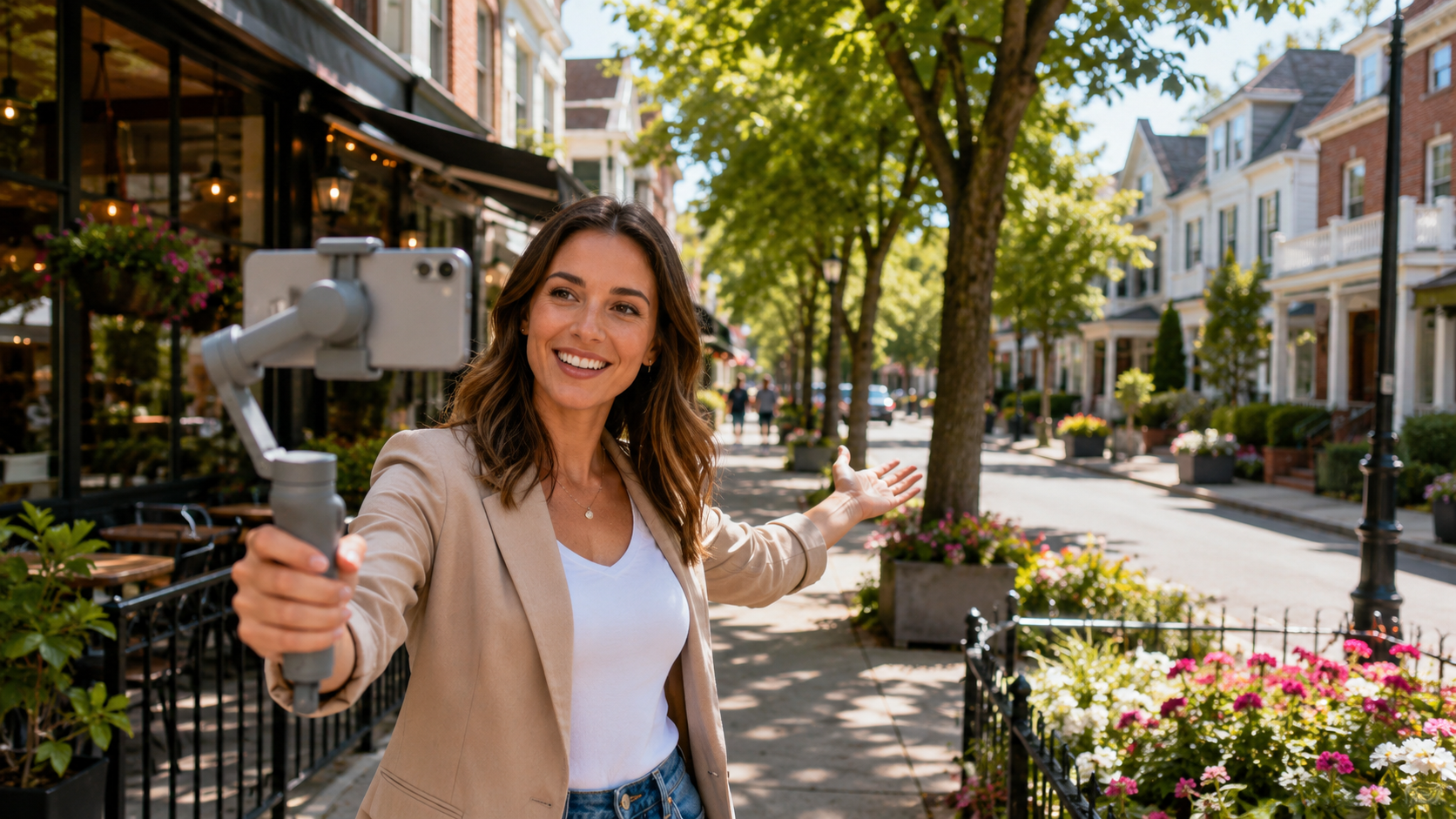
Do not overthink production at the beginning. Good lighting, clean audio, steady footage, and clear delivery are enough to start. Film outside, show real places, and use B-roll of streets, parks, shops, homes, and local landmarks. Keep the pacing lively. Nobody wants to watch a 15-minute video where you stand in one spot and talk like you are reading tax code. Move around, show the area, and speak with energy. You are not making a documentary for film school. You are making a useful, human, local guide that helps people decide whether this place fits their life.
What to Include in Every Neighborhood Video
Every strong neighborhood video should answer the questions buyers and sellers actually care about. Start with where the area is and what it is close to. People need orientation. Mention nearby highways, downtown access, airports, business districts, schools, parks, shopping areas, or major landmarks. Then talk about the overall vibe. Is it quiet and residential? Trendy and walkable? Family-focused? Luxury and private? Affordable and up-and-coming? This is the stuff people want to know but cannot always understand from maps.
Next, cover housing styles and typical buyer profiles. Are there single-family homes, condos, townhomes, historic properties, new builds, acreage homes, or luxury estates? Who tends to love the area? Young professionals, families, retirees, investors, commuters, remote workers? This helps viewers see whether they fit. Then talk about lifestyle. Mention restaurants, coffee shops, gyms, trails, entertainment, grocery stores, schools, and weekend activities. Do not just list them. Explain why they matter. A good guide feels like advice, not a directory.
Finally, include pros and cons. This is where many agents chicken out, but honesty makes your video stronger. Every area has trade-offs. Maybe the homes are beautiful but pricey. Maybe the commute is easy but nightlife is limited. Maybe the neighborhood is walkable but parking is tight. Saying this out loud builds trust because people know you are not just hyping everything. End with a clear call-to-action. Invite viewers to ask for a custom neighborhood match, home search, market update, or seller strategy. Make the next step easy, because attention without action is just noise.
Mistakes That Make Area Guides Feel Cringe
The first cringe mistake is making every neighborhood sound perfect. Buyers know that is nonsense. No area is perfect for everyone. When an agent says every neighborhood is “amazing,” “highly desirable,” and “close to everything,” the content starts sounding like a copy-paste MLS description. Real talk wins. If an area is great but expensive, say that. If it is convenient but busy, say that. If it is developing fast but still has rough edges, say that. Balanced advice makes you sound like an expert.
The second mistake is being too vague. Saying “this area has great amenities” tells people almost nothing. Which amenities? Who are they good for? Why do locals care? Is the park good for families, runners, dog owners, or weekend events? Is the restaurant scene casual, upscale, trendy, or sleepy? Specific details make your video useful. Vague statements make it forgettable. If your video could apply to any neighborhood in any city, it is not local enough.
The third mistake is making the video all about you. Yes, people need to know who you are, but they clicked for the neighborhood. Do not spend the first minute introducing your brokerage, awards, slogan, and life story. Give them value fast. You can build your brand by being useful, not by talking about yourself nonstop. Another mistake is ignoring audio quality. Bad audio makes even good content feel amateur. Use a simple microphone, avoid loud wind, and make sure people can hear you clearly. Production does not need to be fancy, but it should not feel sloppy.
Conclusion
Every Realtor should create local area video guides because they do something most real estate marketing fails to do: they build trust before the client ever contacts you. They help buyers understand lifestyle, not just listings. They show sellers that you know how to market the community around their home. They improve local SEO, create stronger social media content, attract better leads, and make your brand feel more human. In a market where everyone is fighting for attention, local video helps you become useful instead of just loud.
The agents who win with neighborhood video guides are not always the ones with the fanciest cameras or biggest ad budgets. They are the ones who show up consistently, speak clearly, share honest local insight, and make people feel more confident about their next move. Buyers want context. Sellers want proof. Local video gives both sides exactly what they need.
So do not wait until every agent in your market is doing this. Start with one neighborhood. Film one honest guide. Talk about the lifestyle, the homes, the pros, the cons, and who the area is best for. Then do another. Over time, you will build a local content library that works for you every day. That is how you become the go-to Realtor people remember when it is finally time to buy or sell.
Real estate videos, made simple.
Subscribe